Skip links

A History of St. Peter's Church

In September 1845, the Rev. Benjamin Eaton and the Rev. Charles Gillette rode into Brenham and discussed the possibility of an Episcopal parish with local residents at the home of Asa Miles Lewis. Their visit began a story of worship and service that has continued through generations.

Bishop George Washington Freeman and the Rev. John S. Young arrived May 1, 1848. The congregation formally organized St. Peter’s on May 2, the fourth Episcopal parish established in Texas. Worship followed in the courthouse and a log schoolhouse. The Rev. Henry Niles Pierce came to Brenham soon afterward as its first rector and was ordained priest on January 3, 1849.

Pierce’s planned stone church was never finished. A cedar church was in use by 1853, and the parish history also records a building acquired in 1854. The Rev. Lindsey Powell Rucker served in several periods beginning in 1853, with later service as locum tenens and rector emeritus. During his ministry, a Gothic brick church took shape in 1881–1882. After severe damage in the 1900 hurricane, a frame church replaced it on the same foundation in 1901. Foundation repairs and remodeling followed in 1919 during the Rev. S. Moylan Bird’s rectorate. Bird served from 1905 to 1921 and returned from 1929 to 1955.

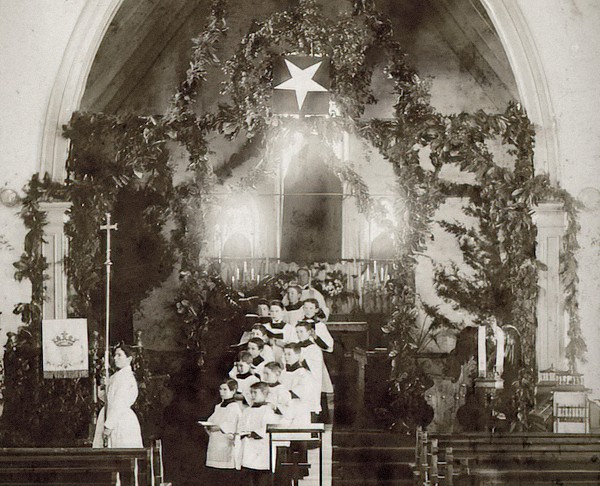
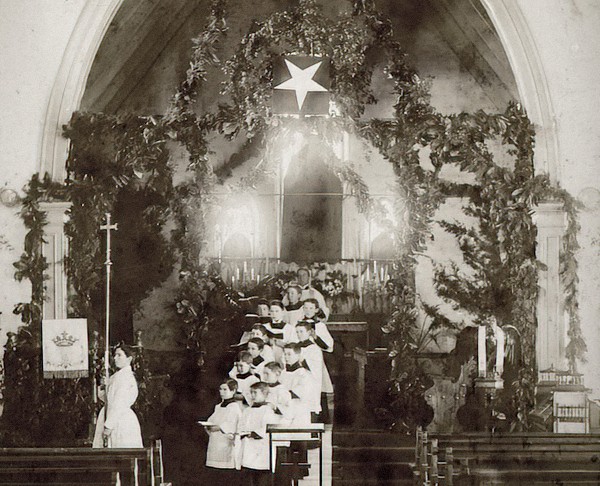
St. Peter’s choir beneath Christmas greenery and a star, 1896
St. Peter’s at Christmas, 1896Historic Christmas choir photograph. Tap the photograph to enlarge.

The Current Church

In 1964, Charles Coates gave three acres at Airline Drive and Hillcrest Lane for a new church. The parish broke ground on St. Peter’s Day, June 29, under the Rev. Joseph H. Frazer Jr. Bishop J. Milton Richardson opened and rededicated the new building on June 29, 1965. Its design echoed the former church, and familiar memorials and furnishings—including the altar, rose window, organ, windows, pews, and bell—came to the new site. The church received a Texas historic landmark designation in 1965. The parish history dates its consecration and cornerstone ceremony to June 9, 1974.

The parish through the years

Faith carried forward

The people of St. Peter’s have brought familiar worship into new spaces, cared for Brenham, and kept the parish’s memory alive. These moments connect the older church to the congregation at Airline Drive today.

Entries are drawn from the parish’s written history, portrait labels, and photographs. * Not verified: the entry is preserved from a written account, but the indicated detail has not yet been confirmed against readable source material. Each entry includes its reference.

1845

The Rev. Benjamin Eaton and the Rev. Charles Gillette visited Brenham and discussed forming an Episcopal parish at the home of Asa Miles Lewis.

Reference: Parish history, p. 127.

1848

St. Peter’s formally organized on May 2. Services followed in the courthouse on May 6 and a log schoolhouse on May 7. Henry Niles Pierce became its first rector.

Reference: Parish history, pp. 100, 102, 127.

1853–54*

Early written accounts describe a cedar church in use by 1853 and another building acquired in 1854. The sequence still needs confirmation.

Reference: Existing parish history narrative — not verified.

1881–1882

A Gothic brick church took shape during the ministry of the Rev. Lindsey Powell Rucker. Bishop Alexander Gregg laid its cornerstone on September 9, 1881; the reproduced inscription reads “Erected 1881-2.”

Reference: Parish history, pp. 102, 106, reproducing the 1881 newspaper account.

1900–1901

The 1900 hurricane severely damaged the brick church. The parish history and a reproduced June 16, 1901 newspaper account describe a frame replacement on the earlier foundation, with older stained glass repaired and reused.

Reference: Parish history, pp. 103, 106, 108.

1905–1921

The Rev. Stephen Moylan Bird served his first period as rector.

Reference: Bird’s framed portrait nameplate supplied by the parish.

1909

A hand-pumped pipe organ built by Henry Pilcher’s Sons of Louisville, Kentucky, was installed. Choir boys or the janitor supplied the pumping.

Reference: Parish history, pp. 128, 172.

1915

Hurricane damage led to further window repairs. Colored panels with white crosses were inserted so surviving glass could be reused to mend broken sections.

Reference: Parish history, pp. 103, 109.

1919

The church underwent foundation repairs and remodeling. Memorials honoring Juliette Shepard Harrison and Sarah Dillard Dwyer were dedicated, including the altar and carved altar rail associated with Father Bird’s designs.

Reference: Parish history, pp. 103, 109, 111, 255.

1920–1921

The Women of the Church raised funds for an electric Pilcher pipe organ. The history dates its purchase to 1920 and identifies the instrument as a 1921 Pilcher.

Reference: Parish history, pp. 129, 172–173.

1929–1955

Bird returned for a second period as rector, continuing his long association with the parish.

Reference: Bird’s framed portrait nameplate supplied by the parish.

1948–1949

St. Peter’s celebrated its centennial on May 2, 1948. The Coates family’s parish house, known as Bird House, was dedicated in June 1949 in honor of the Rev. S. Moylan Bird.

Reference: Parish history, pp. 111, 129, quoting the June 28, 1949 Banner-Press.

1953

On December 21, the parish celebrated Father Bird’s fiftieth anniversary of ordination to the priesthood.

Reference: Parish history, p. 129; earlier jubilee photographs and invitation.

1955

The Rev. Herbert J. Beadle Jr. became rector on October 1.

Reference: Parish history, p. 62; Beadle portrait caption, p. 77.

1956

The vestry established a separate fund for the Book of Remembrance on March 14. Mrs. Cecil Burch was appointed its administrator.

Reference: Parish history, p. 62.

1958

A bid to heat and air-condition the church and Parish House was accepted. The vestry also approved an annual organ inspection.

Reference: Parish history, p. 62.

1959

The Rev. James L. Considine Jr. became rector on July 15. A loudspeaker system was approved that fall.

Reference: Parish history, p. 63.

1961

Following discussion of substantial repairs to the old church, the vestry voted on December 11 in favor of a new church building at a new site.

Reference: Parish history, pp. 63, 129.

1964

Charles Coates donated three acres for the new church. Groundbreaking took place on St. Peter’s Day, June 29, at Airline and Hillcrest.

Reference: Parish history, p. 66, quoting the Banner-Press of June 25 and June 30, 1964.

1965

Bishop J. Milton Richardson opened and rededicated the new church on June 29. Familiar furnishings, memorial windows, the organ, and the bell came from the old church.

Reference: Parish history, p. 67, quoting the Banner-Press of June 29–30, 1965.

1965–66

The church received Recorded Texas Historic Landmark recognition. By February 1966, its medallion and plaque had arrived; the marker included the word “Replica.”

Reference: Parish history, p. 68, quoting the Banner-Press of October 10, 1965, and February 2, 1966.

1968

The vestry recorded a motion to set up an Endowment Fund at its September 30 meeting.

Reference: Parish history, p. 68.

1973–1974

The history reports that the church debt was paid in full in 1973. The church was consecrated on June 9, 1974, with Bishop J. Milton Richardson preaching and the cornerstone laid on the same occasion.

Reference: Parish history, p. 130; cornerstone photograph.

1976

Sue Muzzy and Dr. Beatrice Stinnett became the first women to serve on the vestry. The parish purchased a replacement rectory, and memorial gifts provided an Ambassador Carillon from Schulmerich.

Reference: Parish history, pp. 71, 83, 120–123, 130.

1977

The Rev. John R. Bentley Jr. began his duties as rector on August 1, with August 7 as his first Sunday.

Reference: Parish history, p. 85, quoting a Banner-Press biography.

1978–1979

George Babb rebuilt the Pilcher organ, celebrated at a November 26, 1978 concert. By March 12, 1979, stained-glass restoration and protective storm-window work were complete, funded by the Episcopal Church Women and the Spec Shop.

Reference: Parish history, pp. 85–86, 130, 172–173, 256.

1980

The history recognizes Cathy Stuckert as the parish’s first woman lay reader during this period.

Reference: Parish history, pp. 86, 144, 149. The chronology on p. 130 places Cathy’s milestone earlier; its exact year remains under review.

1981

The parish announced an additional Rite II Eucharist beginning September 10, continuing its life of worship and formation.

Reference: Parish history, p. 277.

1982–1983

Planning advanced for a new parish hall and additional Sunday School space. In 1983, parishioners built a playground fence, and the Book of Remembrance funded equipment.

Reference: Parish history, pp. 279–280, 284–285.

1984–1985

John R. Bentley Jr. concluded his rectorate on November 30, 1984. Robert L. Gribble preached his first sermon as rector on March 31, 1985. His installation and groundbreaking for the new Parish Hall Facility followed on May 26.

Reference: Parish history, pp. 100, 285–287.

What came from the old church?

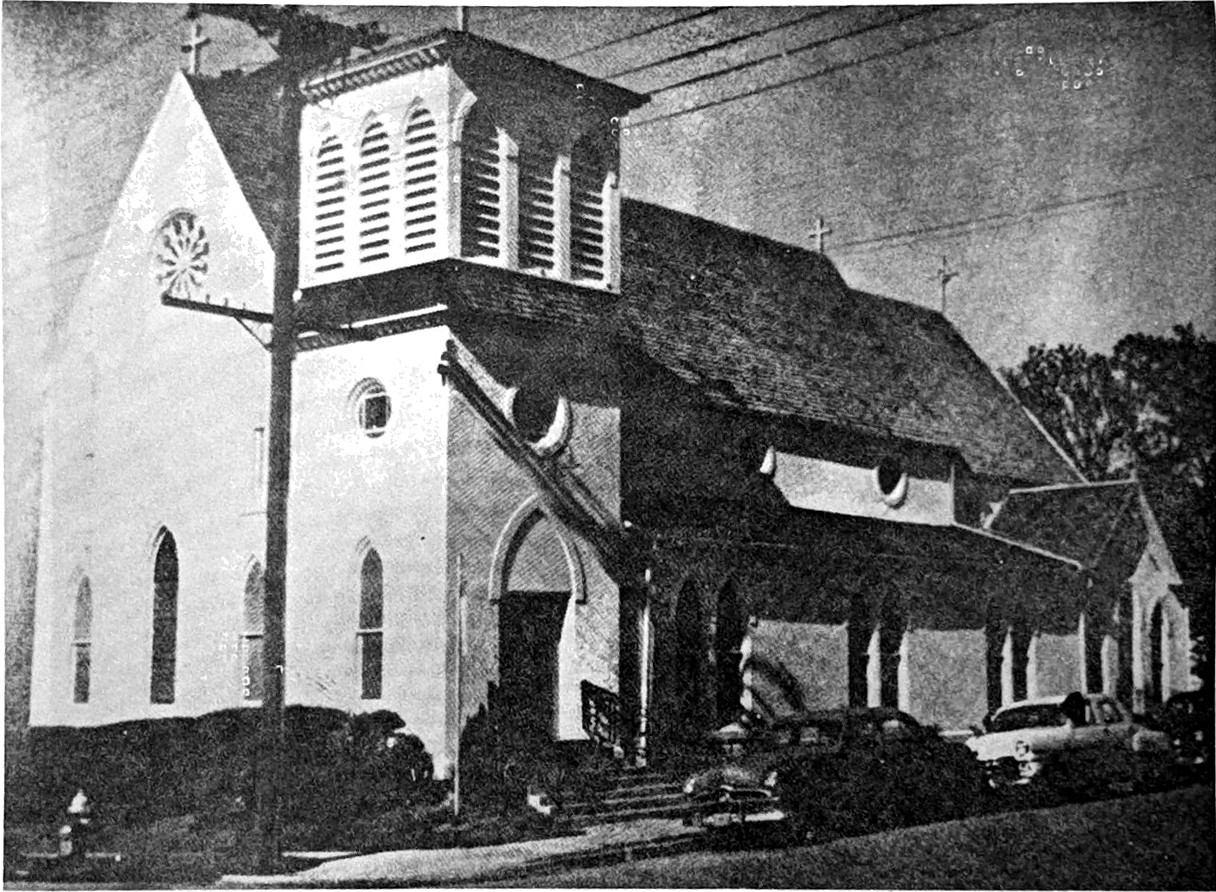
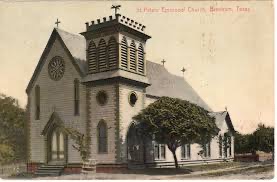
Historic postcard showing the former St. Peter’s church

The former church

Historic postcard view of St. Peter’s former church. The date of this image has not been verified.

When the parish moved to Airline Drive in 1965, it brought many of the familiar furnishings and memorials from the former church: the pews, altar, altar rail, wainscoting, organ, carpets, rose window, and other memorial windows. The historic church bell was mounted in the new bell tower. These objects continued in use, preserving a tangible connection with generations of worship at St. Peter’s.

Source: the parish history, page 67, quoting the Brenham Banner-Press of June 29, 1965.

People who carry the story forward

A parish shaped by faithful service

Father Bird’s lasting influence

Stephen Moylan Bird’s ministry extended into the daily care of the church, its music, and its furnishings. The history credits him with designing the carved altar and altar rail, and recalls his work as priest, organist, and choir director. Beatrice Stinnett’s remembrance describes a pastor devoted both to his parish and to people throughout Brenham.

Sources: parish history, pp. 172, 177, 255, 320–321.
Serving and preserving

Cathy Stuckert, recognized as the parish’s first woman lay reader, also made the drawings that illustrate Christian symbols in the parish history. John Herndon prepared photographs for publication. Betty Cantrell Plummer, one of the manuscript’s editors and a historian of Brenham and Washington County, helped preserve the parish’s story.

Sources: parish history, pp. 86, 149, 329–330. Accounts differ on the exact year Cathy first served as lay reader.

Gifts of hand and heart

The Women of the Church raised funds for the Pilcher organ through sales, bazaars, and dinners. Their needlepoint and memorial projects brought parishioners’ gifts into worship. In 1979, the Episcopal Church Women and the Spec Shop paid for completion of stained-glass restoration and protective storm windows.

Sources: parish history, pp. 86, 130, 172, 255, 264.

Architecture and continuity

A familiar church in a new setting

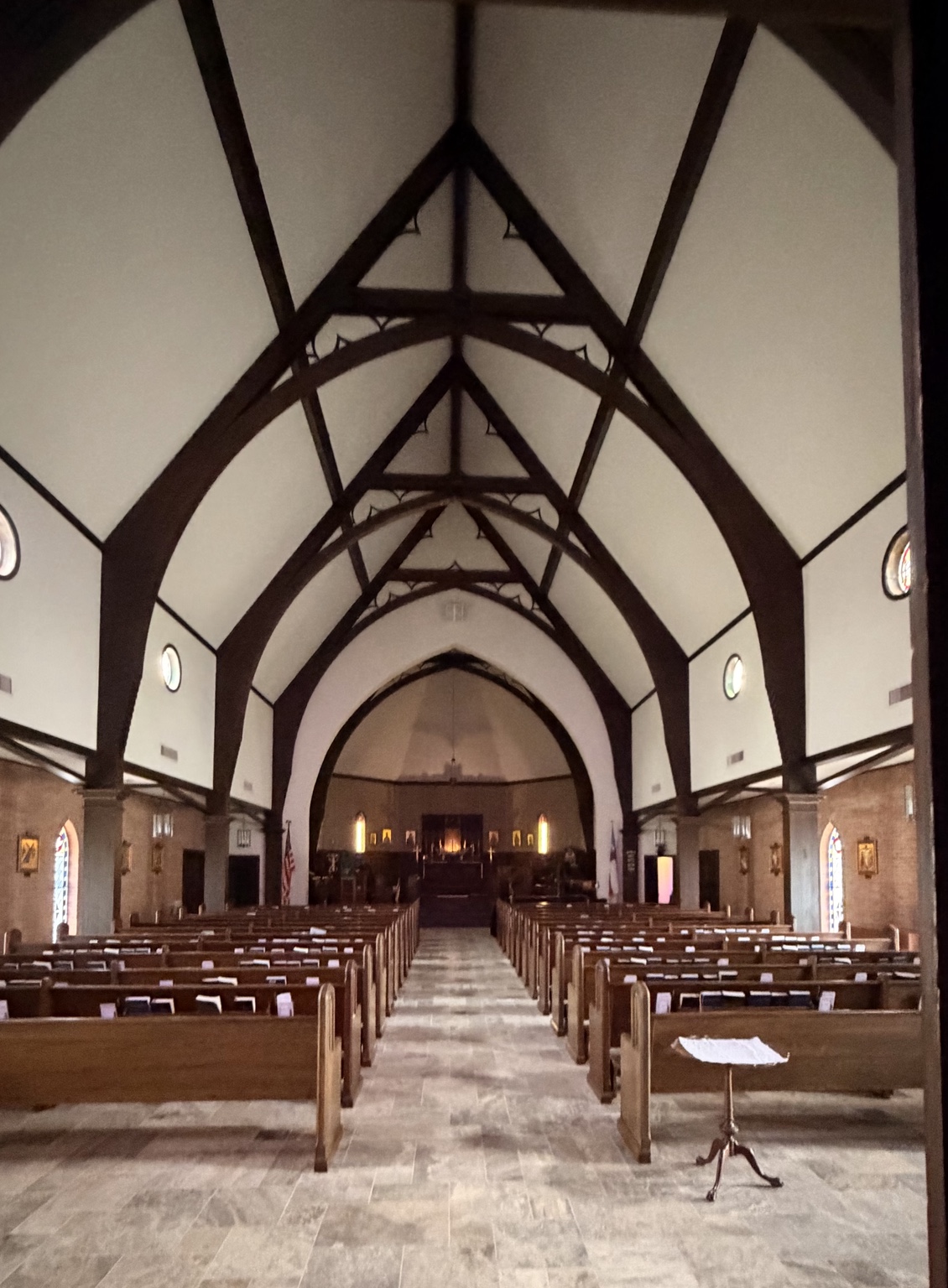
The present church carries forward the Gothic character of its predecessors through pointed arches, stained glass, dark wood, and the long view toward the altar. The parish history describes laminated wooden columns and arches rising toward the vaulted ceiling, with trefoil forms beneath the ridge. These three-lobed designs recall the Holy Trinity.

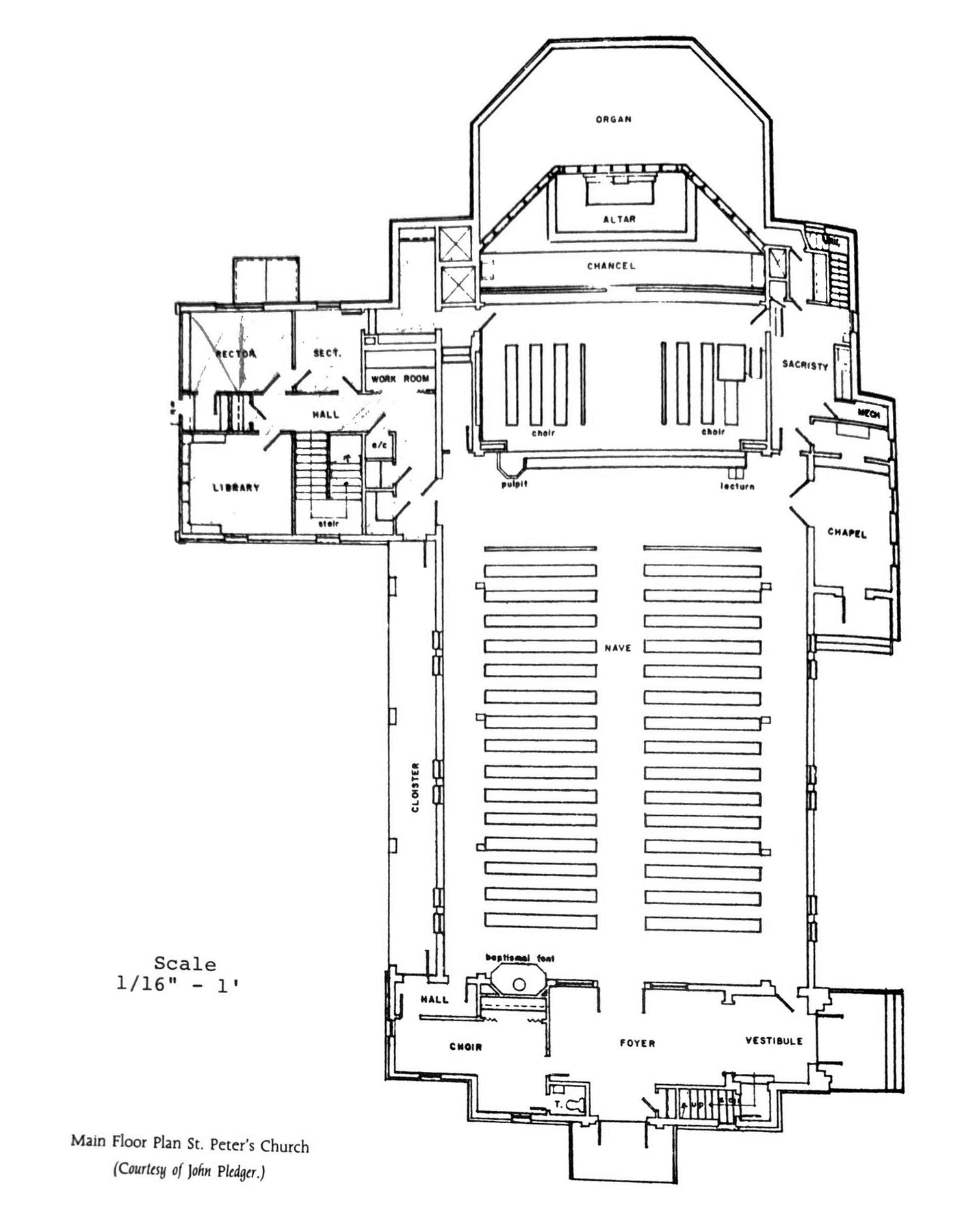
The larger red-brick church at Airline Drive also provided a narthex and balcony, All Souls’ Chapel, offices, and rooms below for teaching, fellowship, and service. The book’s construction photographs show the nave arches and front entrance taking shape; its main-floor plan records the arrangement of rooms and seating at that time.

Sources: parish history, pp. 103–104, 114, 118, 336–337. Room uses and finishes described in the historical volume reflect its period.

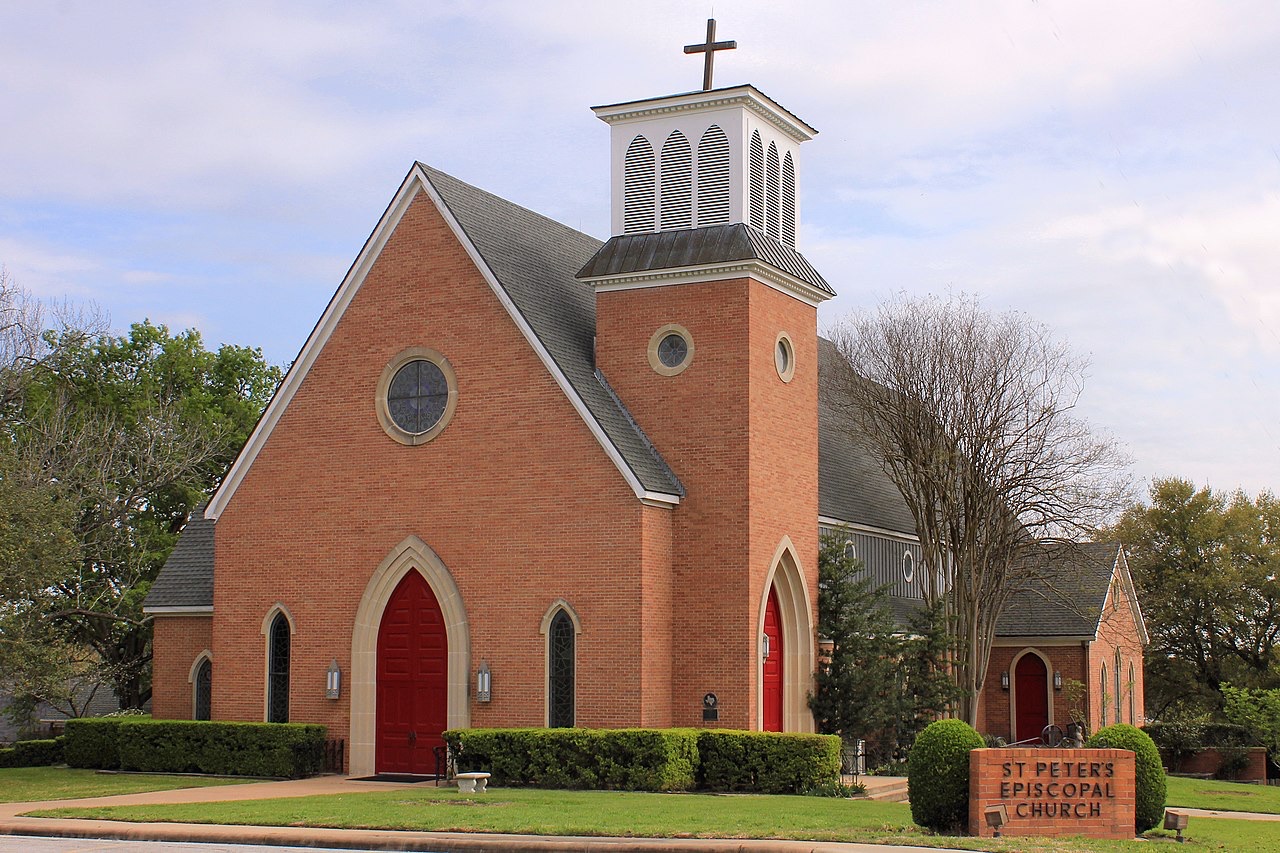
Present St. Peter’s Episcopal Church exterior

The church at Airline Drive

The present church exterior, with its brick tower, rose window, and red doors.

Central aisle, pews, and roof arches of St. Peter’s nave

The nave

Pews and timber arches frame the central aisle leading toward the chancel.

Light carried through the years

Windows that survived, moved, and were restored

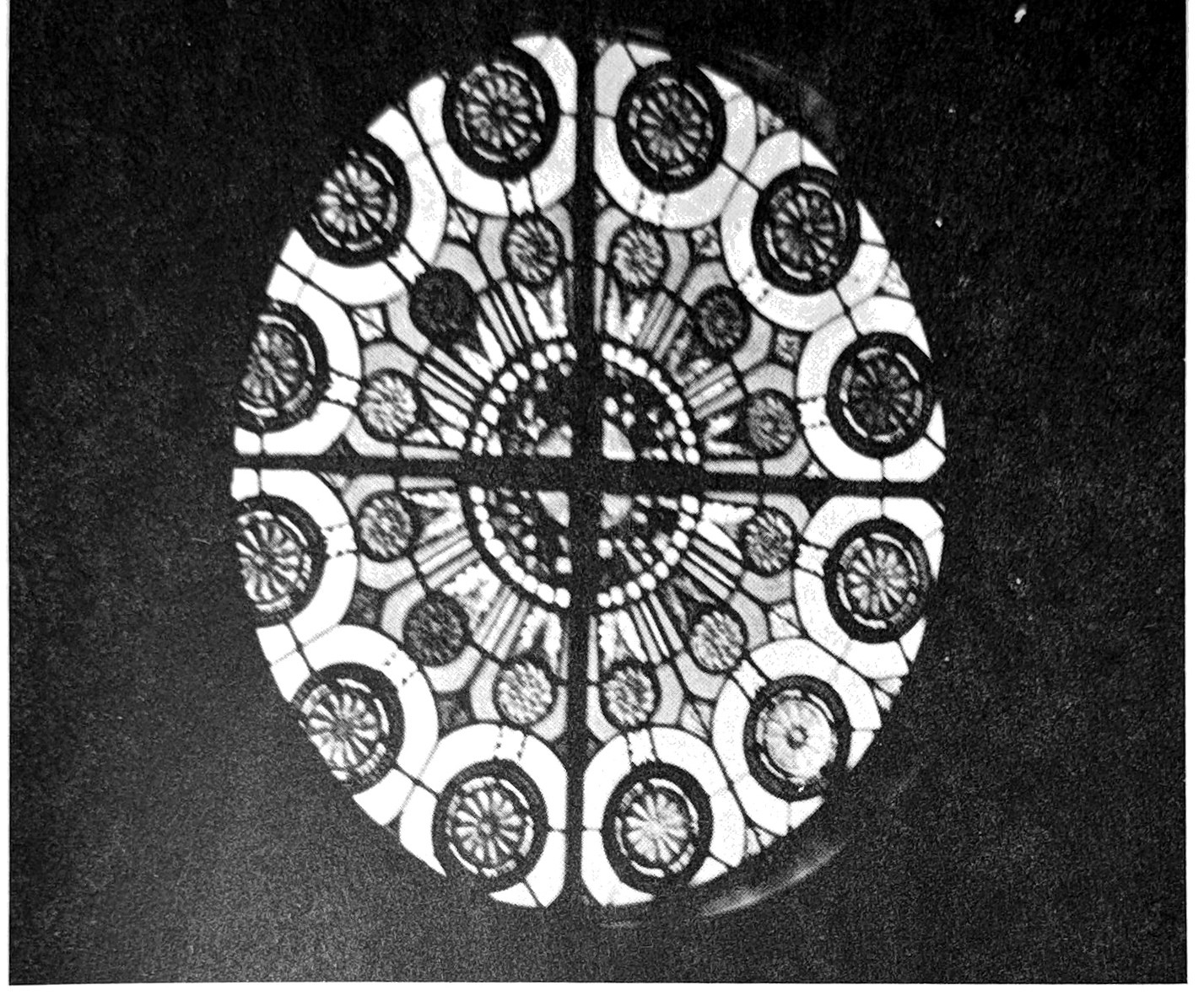
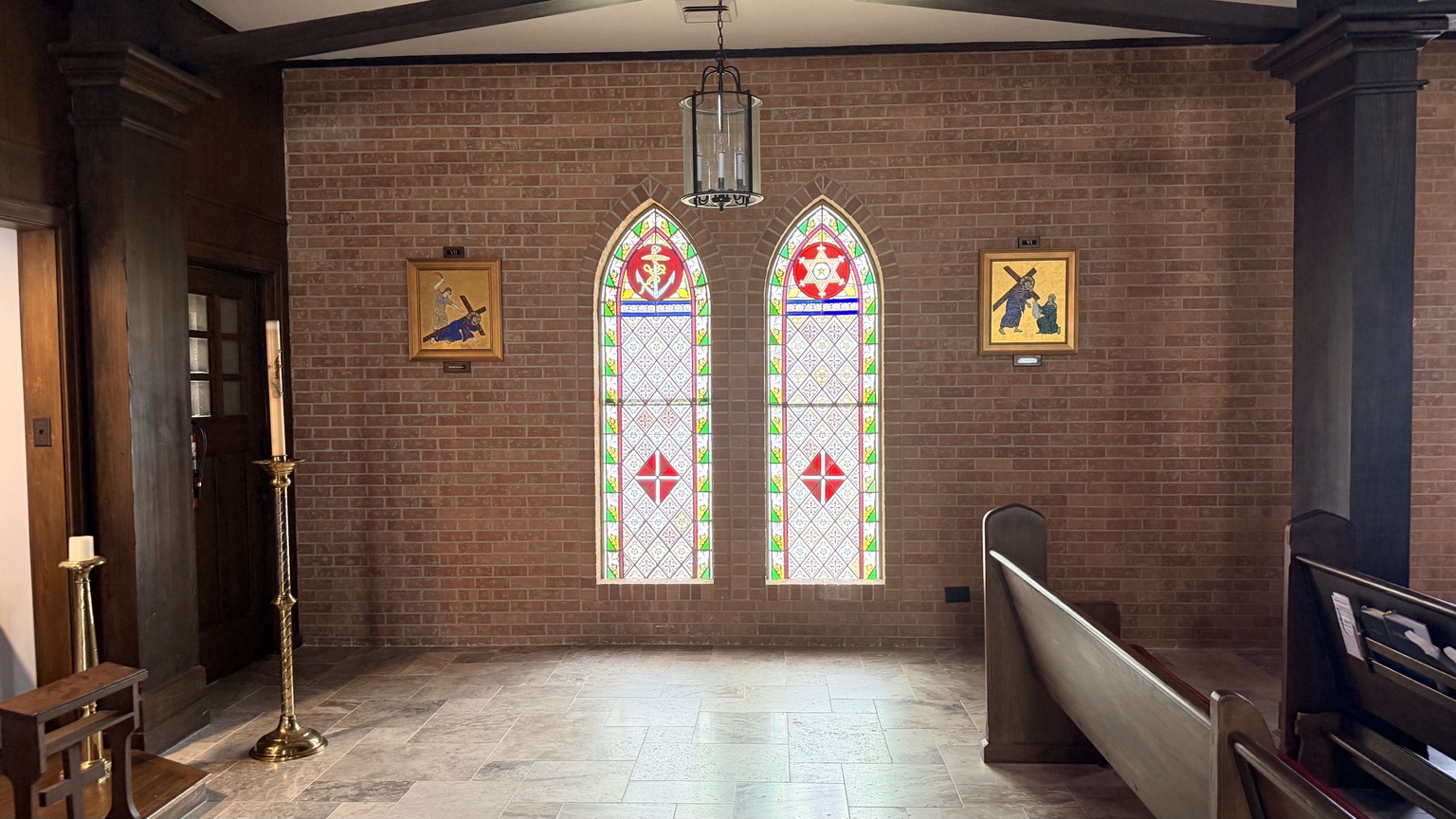
After the 1900 hurricane, older stained glass was repaired and reused in the 1901 church. The history reports that the badly damaged rose window was sent to St. Louis for restoration. Following another hurricane in 1915, colored panels containing white crosses were inserted in damaged windows so other surviving glass could be used to repair broken sections.

Many windows moved with the parish in 1965. The book reports that the large window and two Rucker memorial windows in All Souls’ Chapel had stood above the altar in the 1881 church. Further restoration, including protective storm windows, was completed by March 1979.

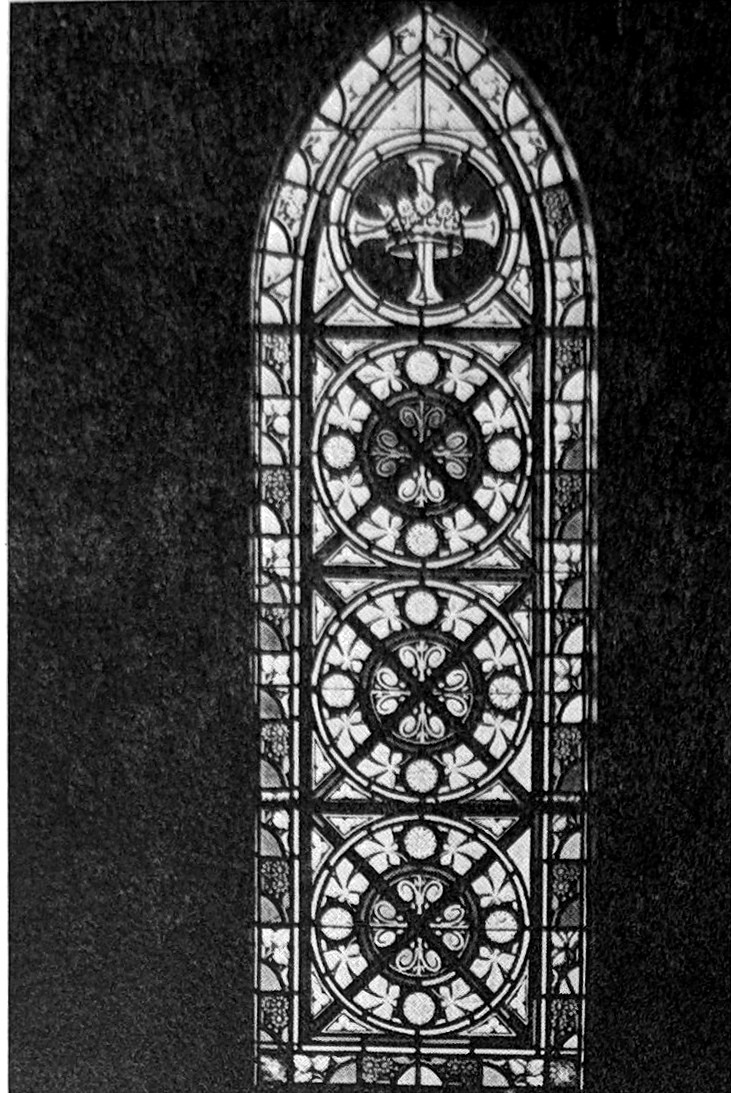
The book identifies St. Andrew with his X-shaped cross, the descending dove, a dove with an olive branch, the crown and cross, roses, and sacred monograms among the symbols in the glass. These details invite a closer look at the faith expressed in the church’s windows.

Sources: parish history, pp. 90, 101–103, 108–109, 130–131, 137, 269; the “Cross and Crown” symbolism page. Window locations are those recorded in the book.

Paired memorial windows featuring Christian symbols

Symbols in the windows

Paired windows with Christian symbols above patterned glass.

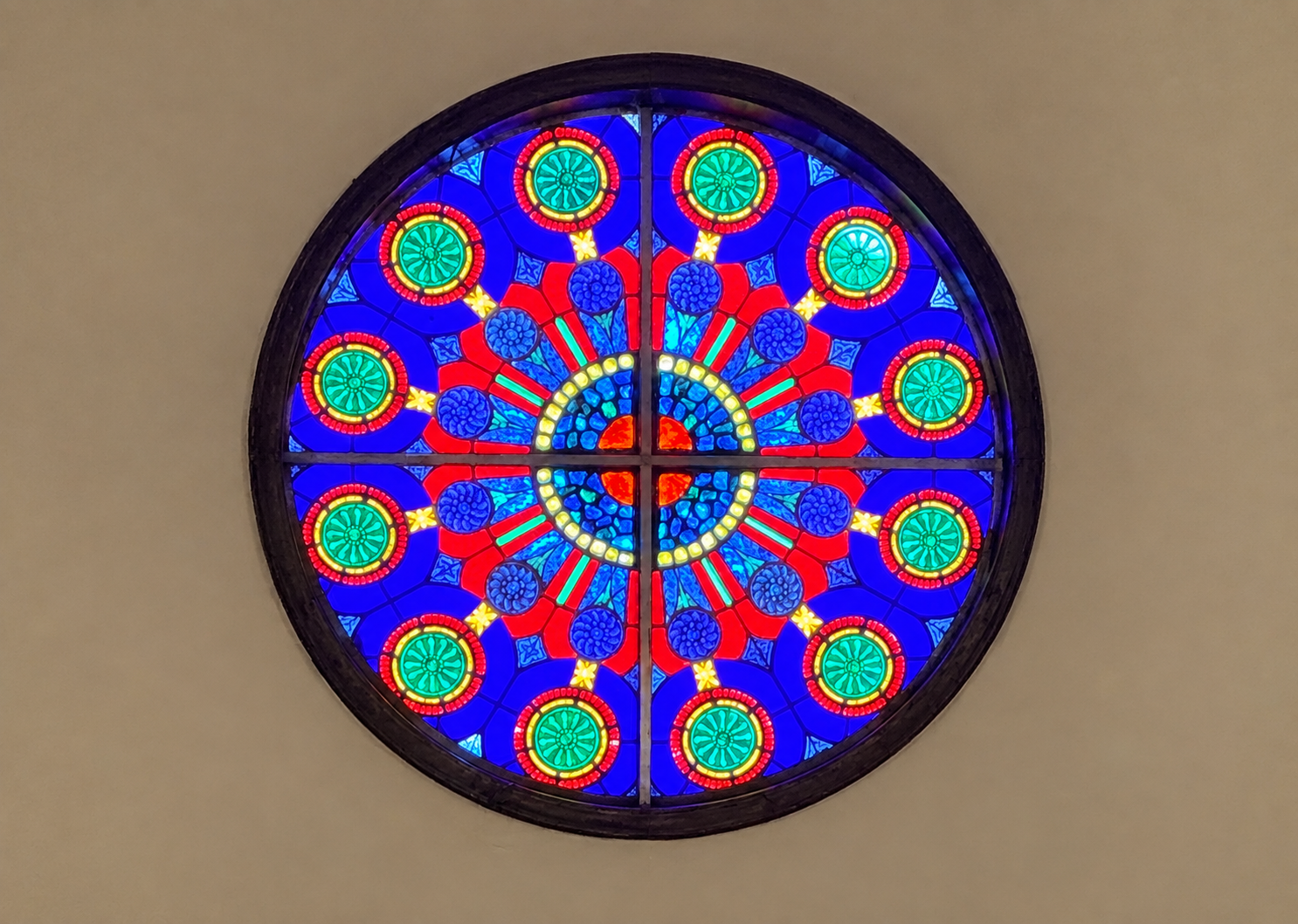
St. Peter’s rose window with its complete black circular frame and surrounding wall

The Rose Window

The rose window was brought from the former church to the present building in 1965. The photograph’s outer frame and wall have been digitally completed for balanced framing.

Craftsmanship and remembrance

The stories behind the furnishings

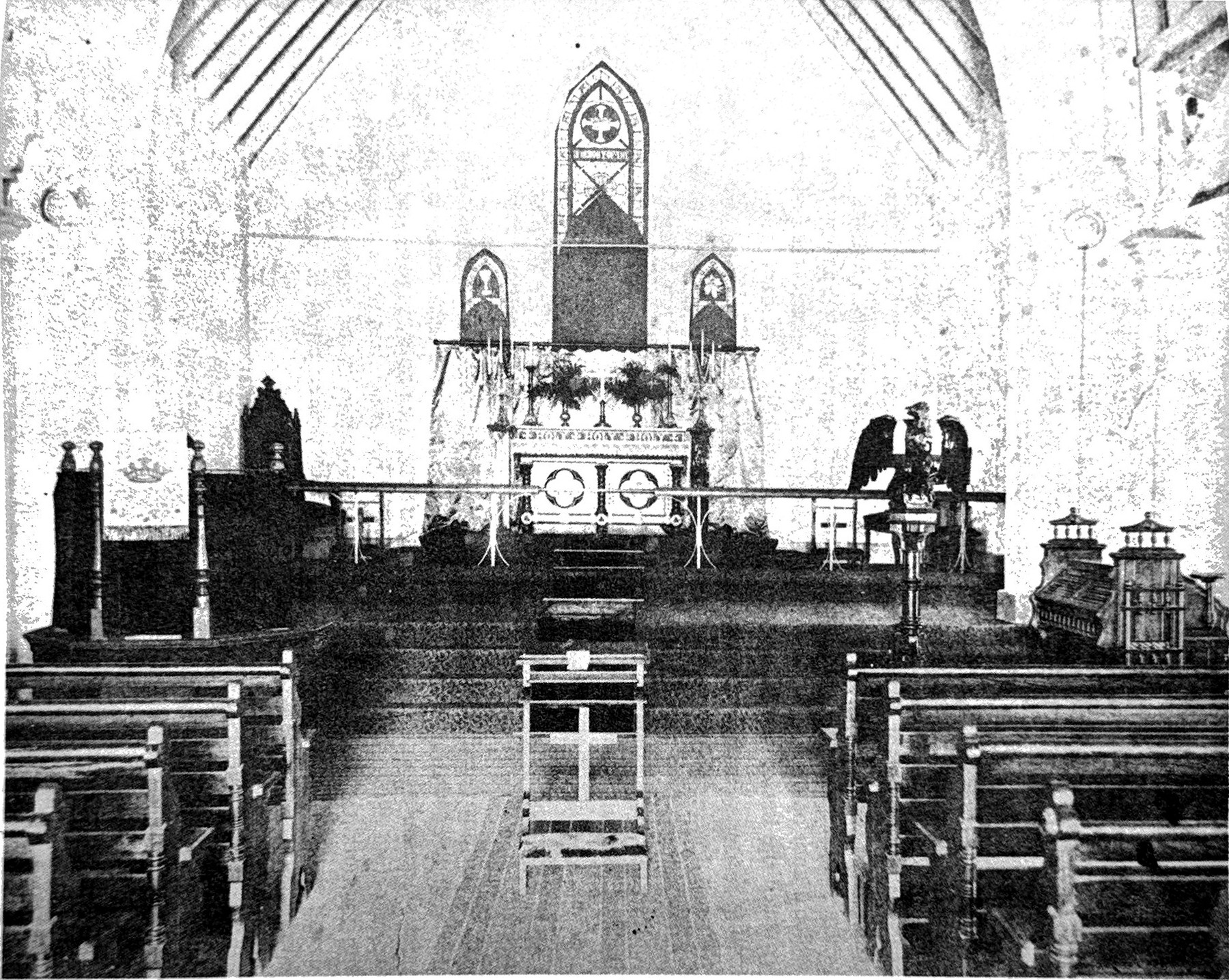
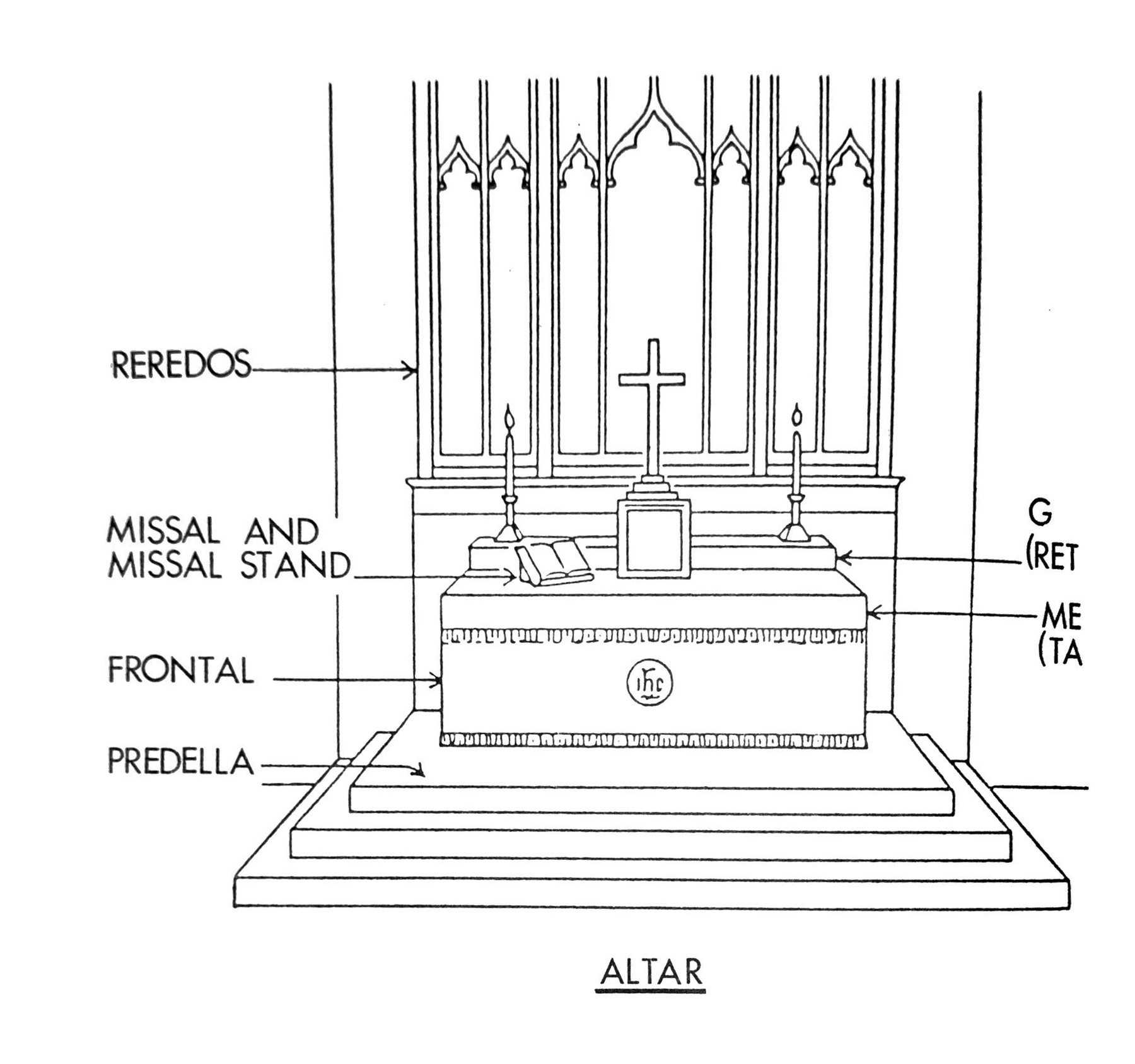
The altar and reredos

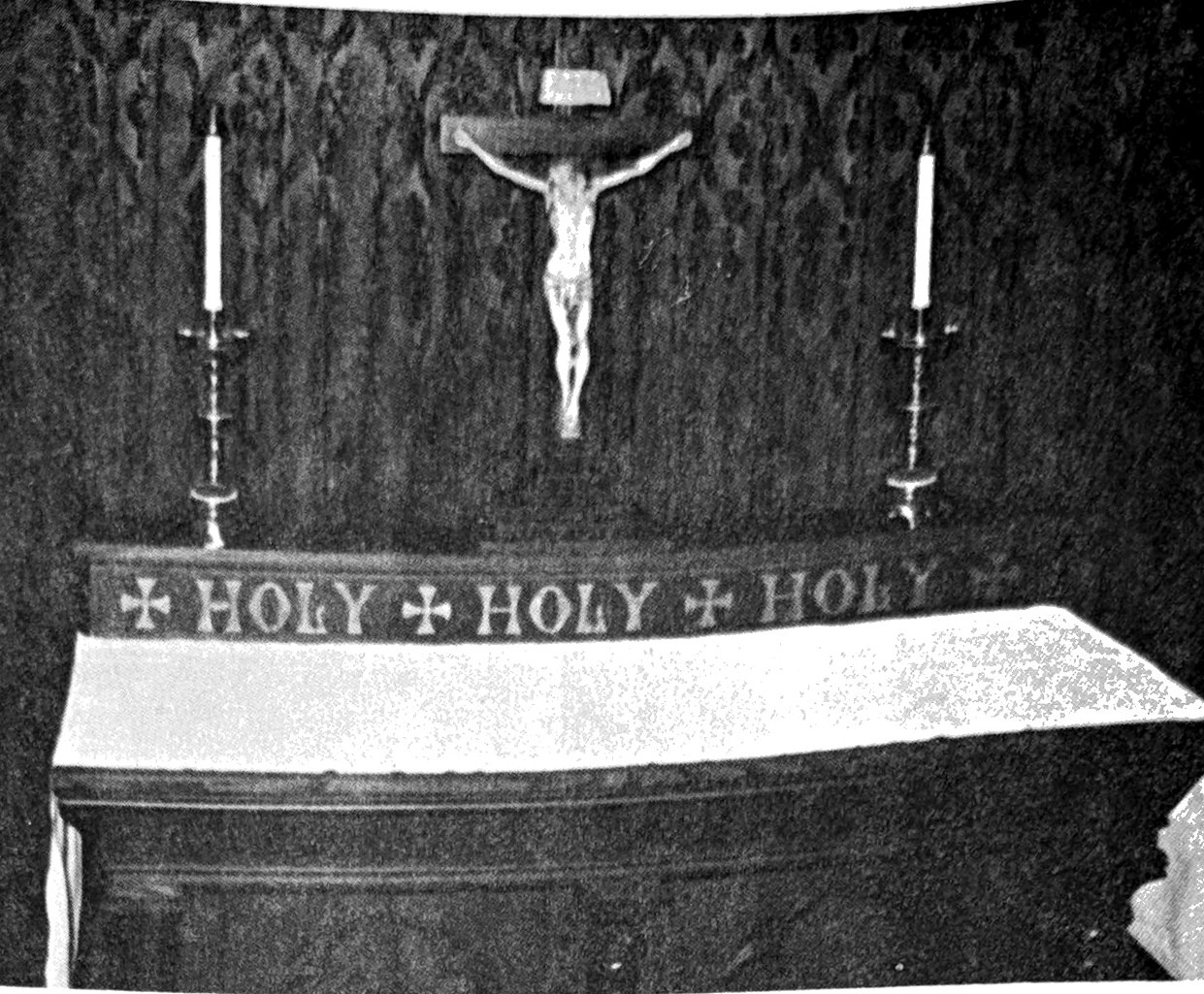
The parish history credits Father Bird with designing the altar, hand carved in England in 1919. It was given by the children of Juliette Shepard Harrison in her memory. The carved framework behind and above the altar is the reredos.

Sources: parish history, pp. 109, 111, 255.

The grape-carved altar rail

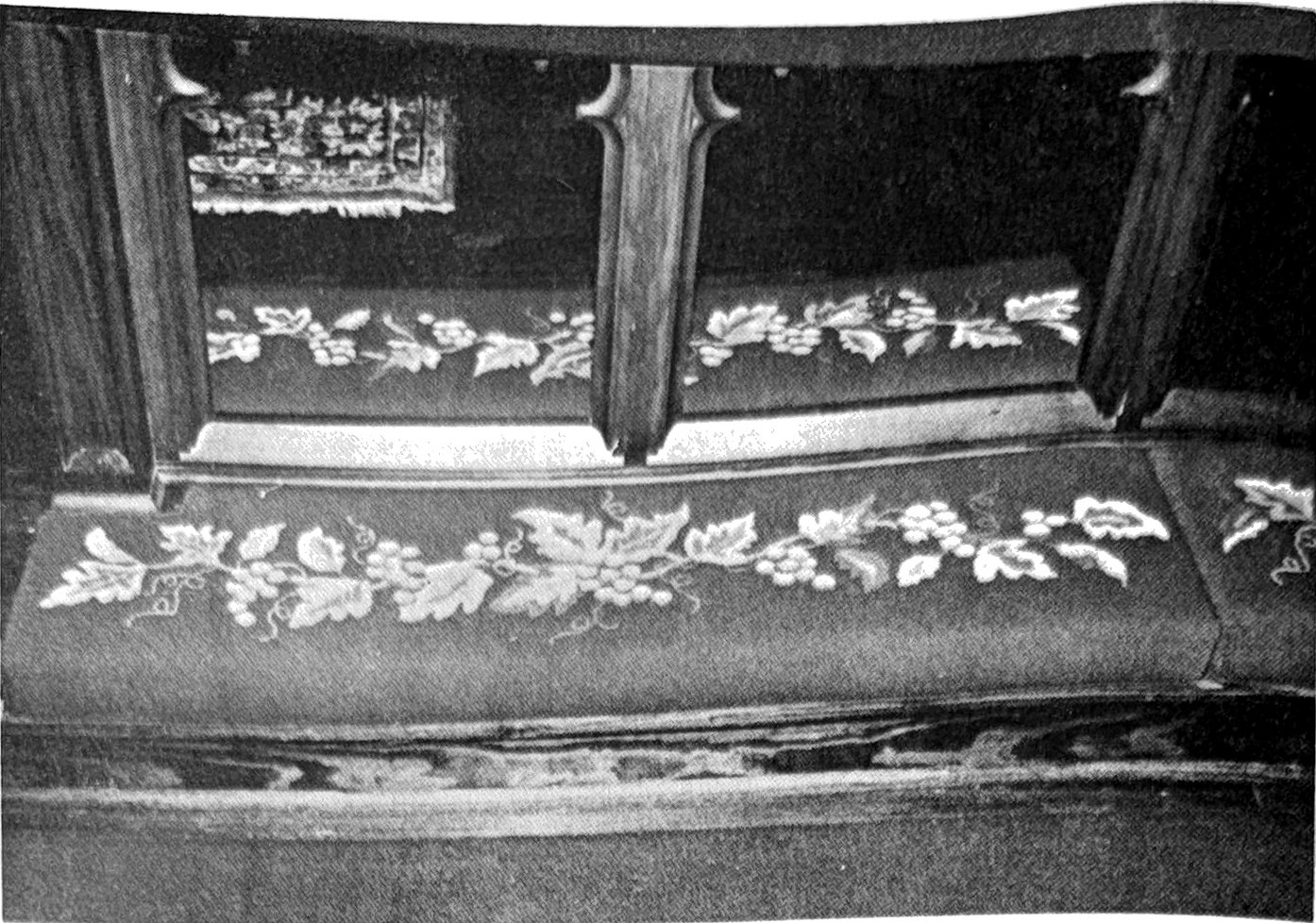
Also designed by Father Bird and hand carved in England, the rail was given by Mary Dwyer Ross in memory of her mother, Sarah Dillard Dwyer. Its grape motif is echoed in needlepoint kneeling cushions worked by the Women of the Church.

Sources: parish history, pp. 111, 255, 264.

Woodwork and memorials

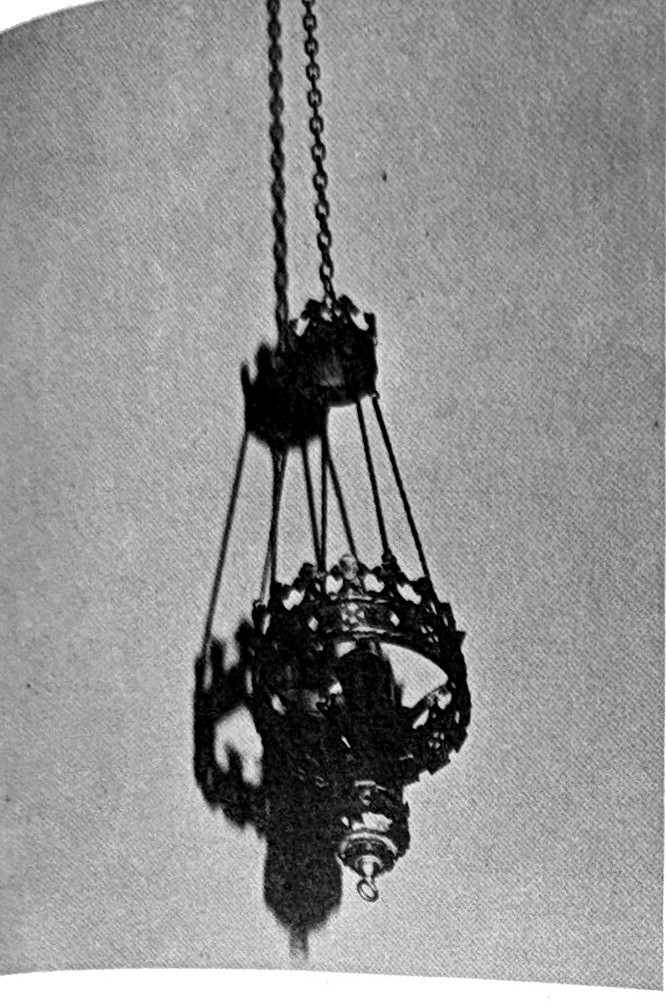
Oak wainscoting from the former church was incorporated into the new chancel and sanctuary, with additional panels added for the larger space. The older woodwork was given in memory of Frederick Schurenberg in 1919. The sanctuary lamp and other memorials record the gifts of the Krug, Wilkins, Lamkin, Southern, and other parish families.

Sources: parish history, pp. 255, 267, 272.

Handwork in worship

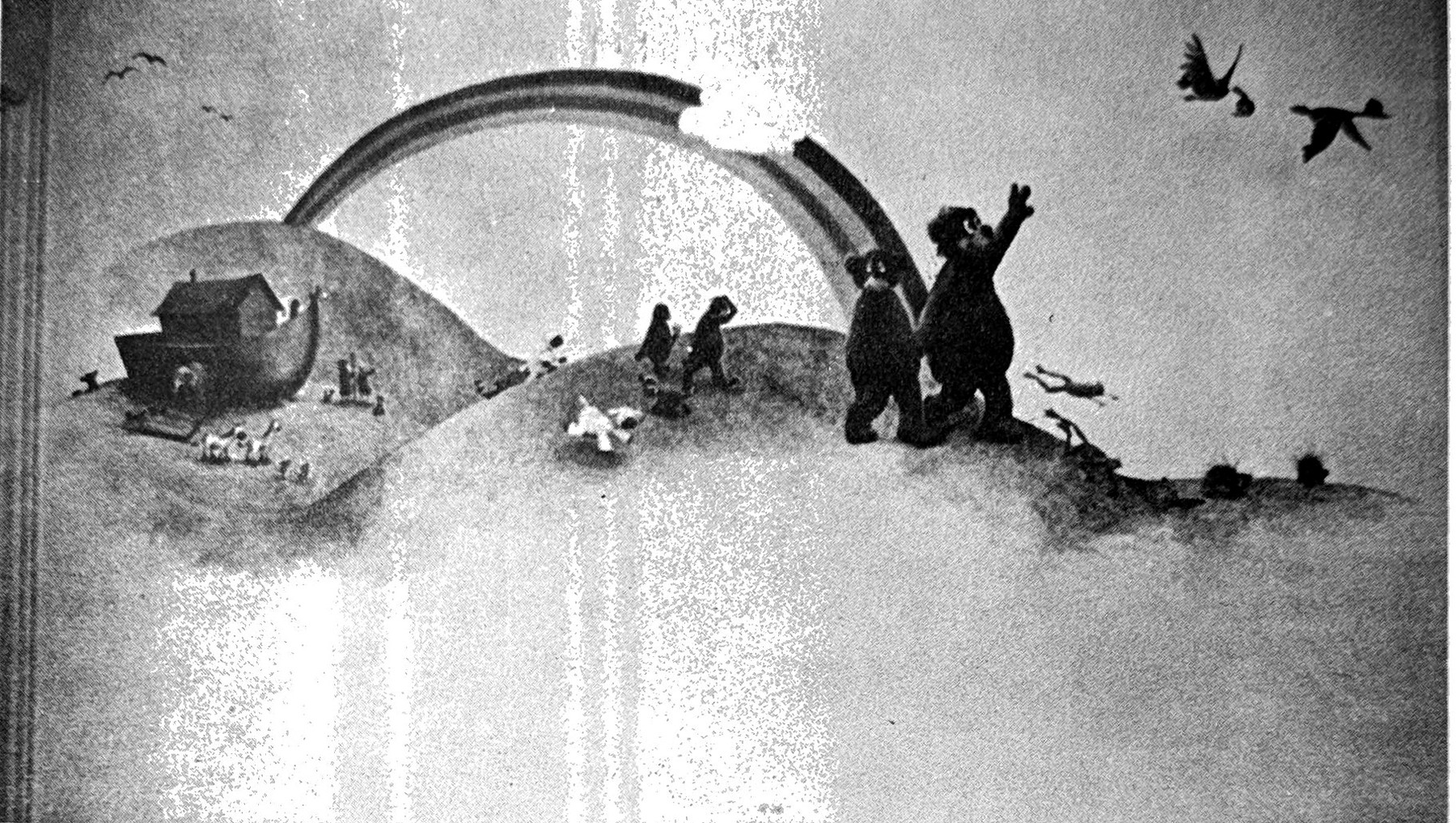
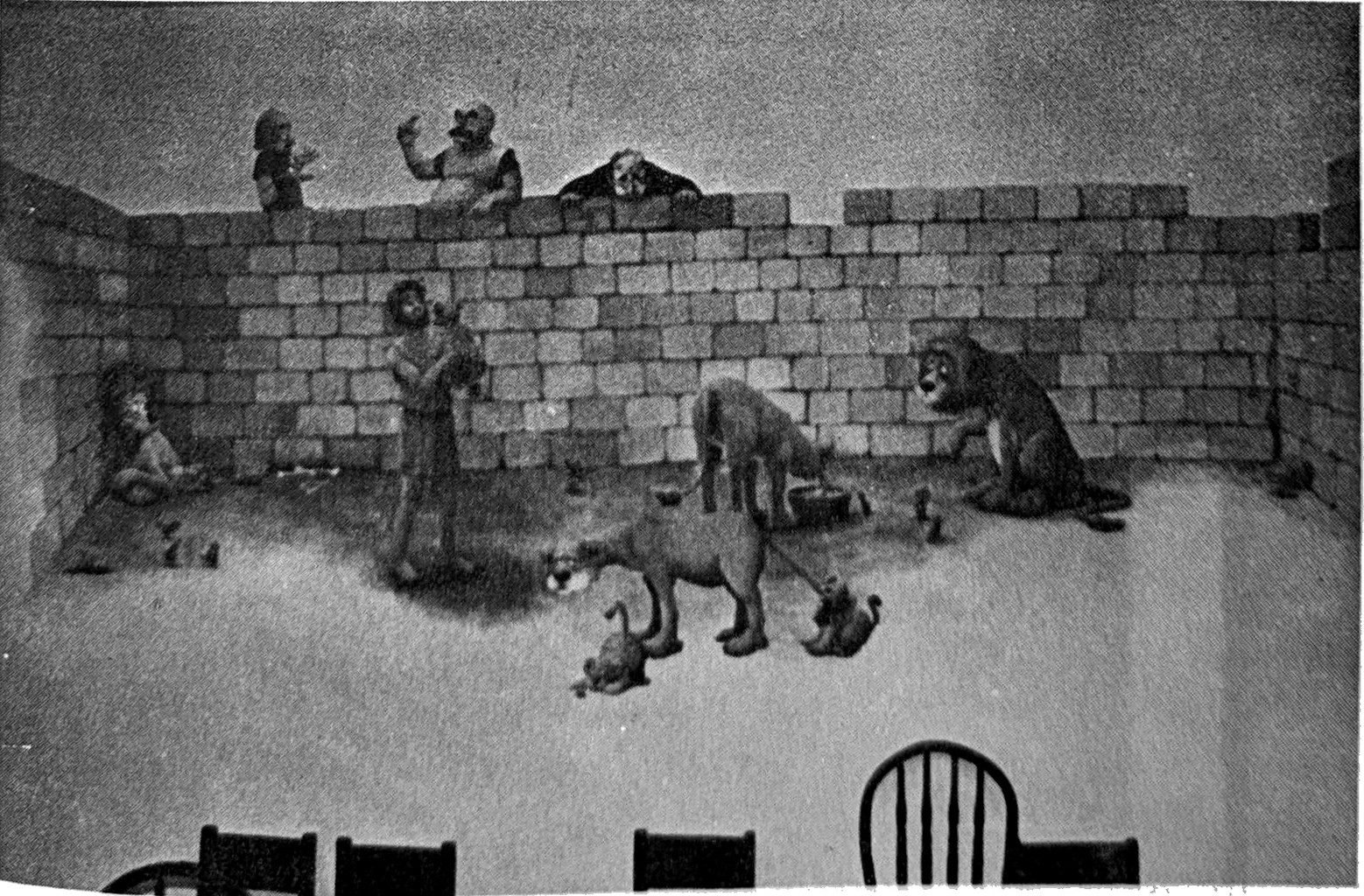
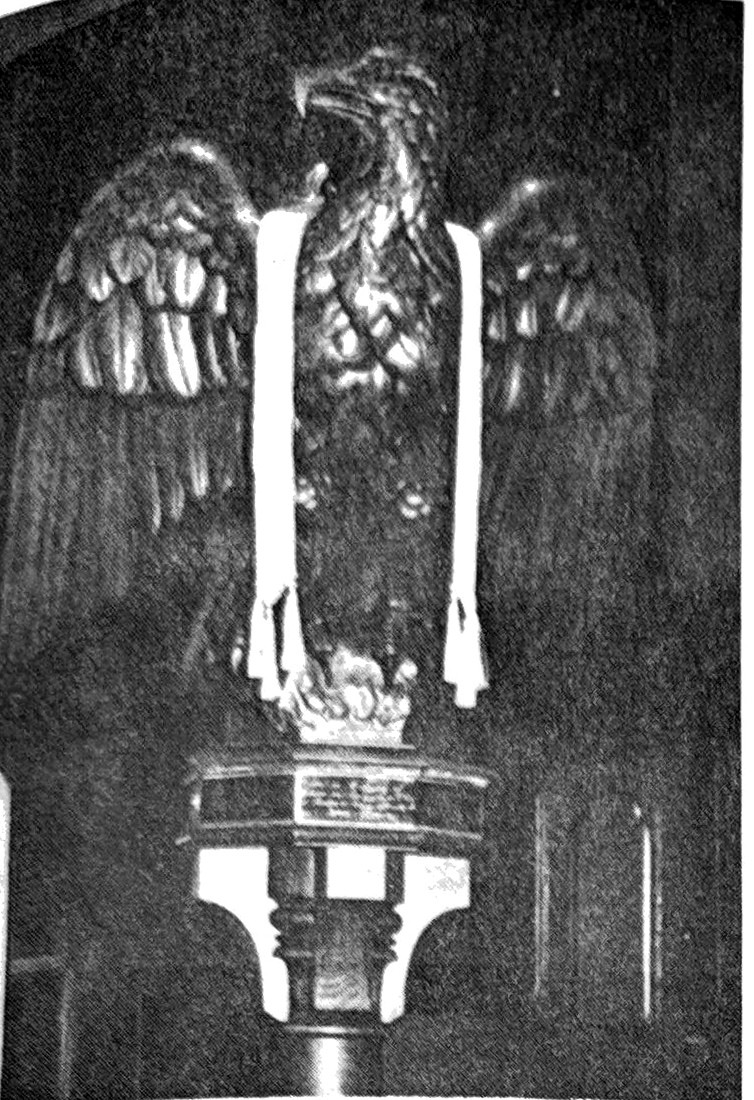
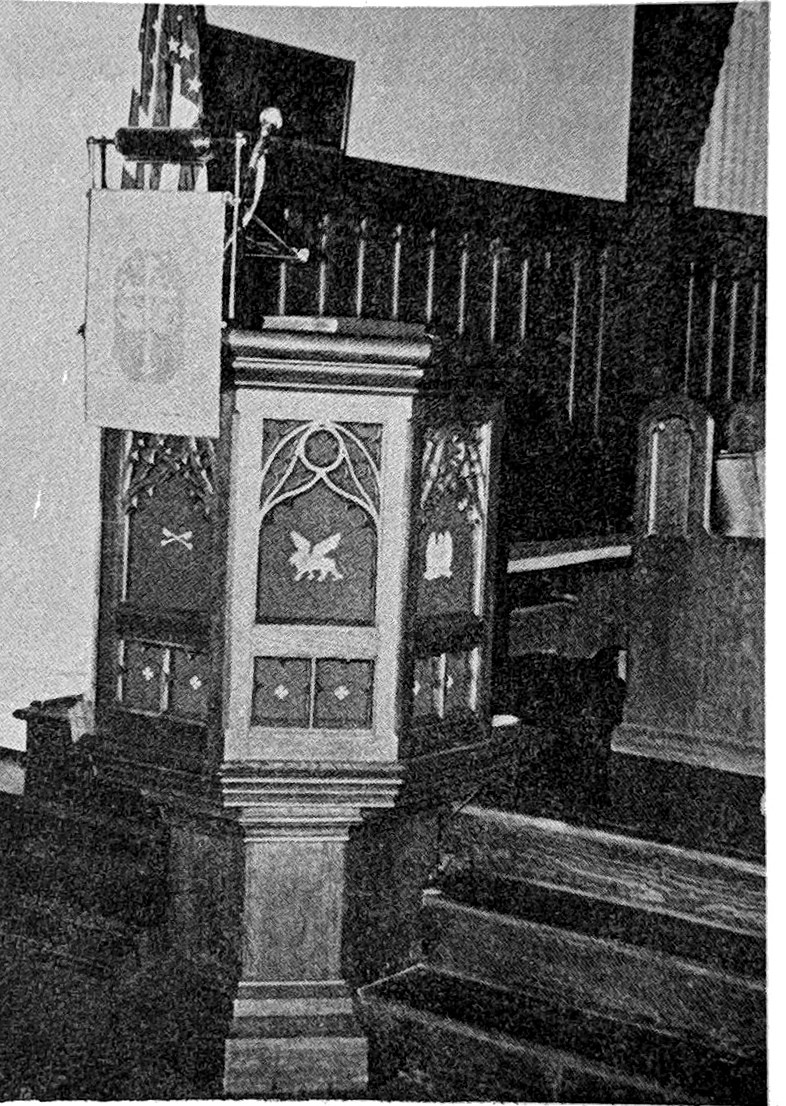
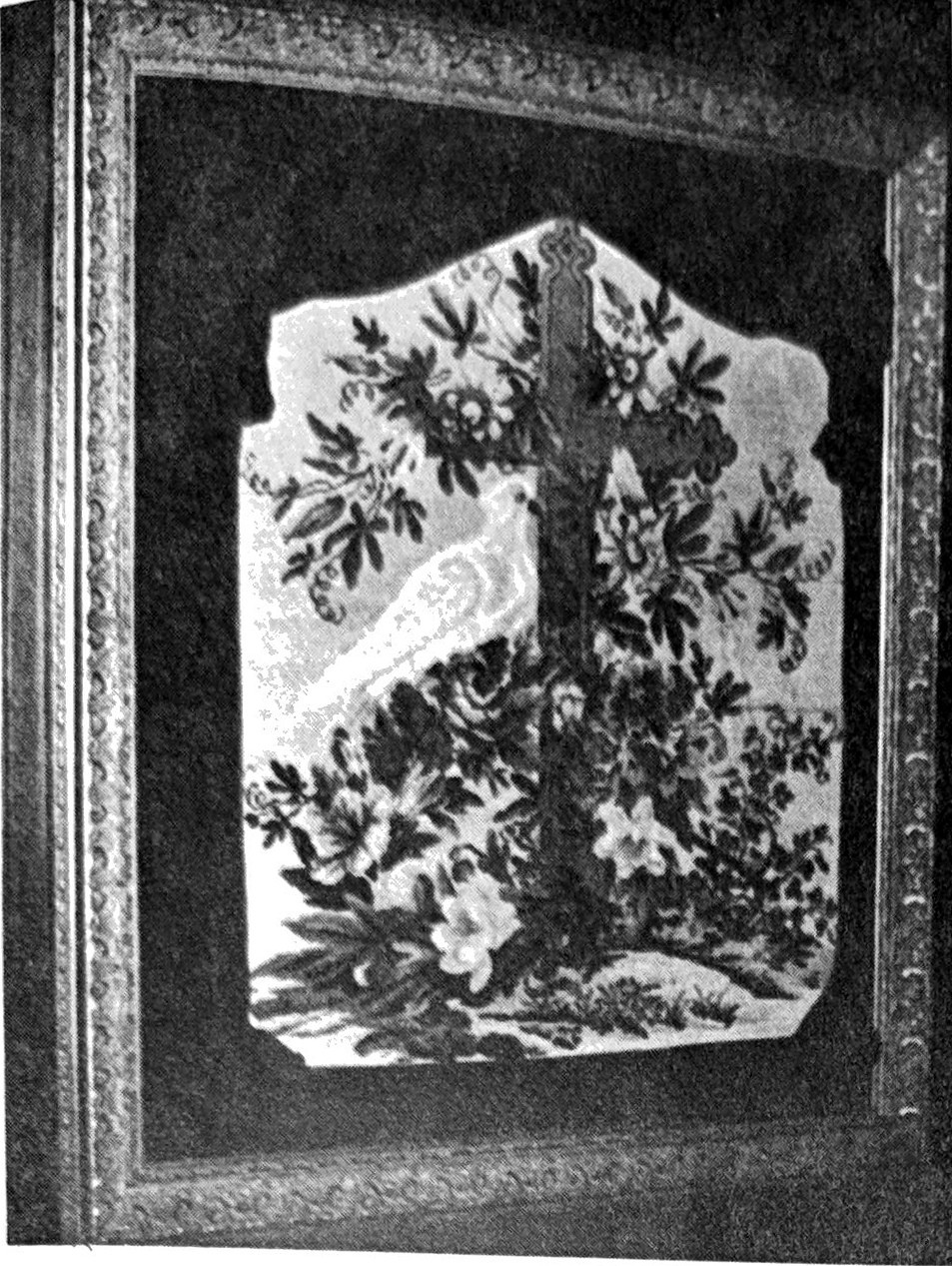
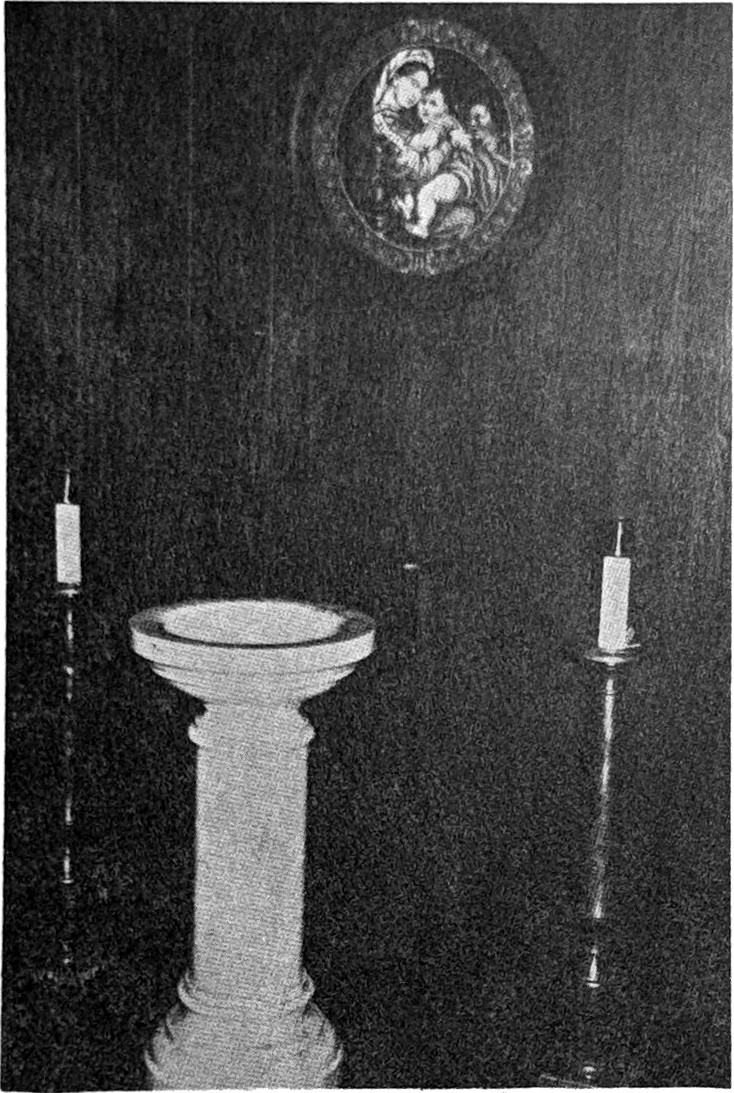
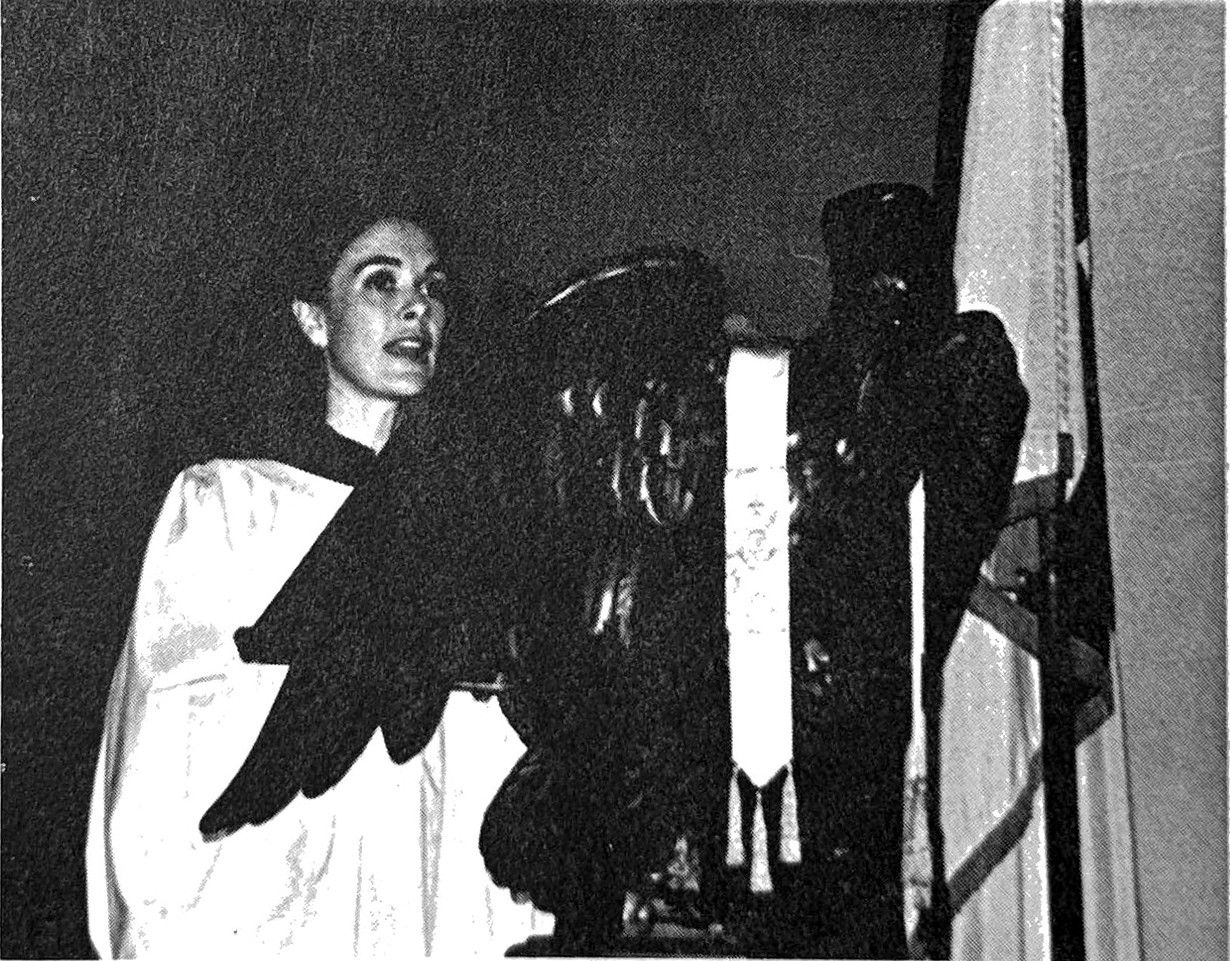
Needlepoint cushions and hangings carry Christian symbols into the sanctuary. The book also preserves archival views of the eagle lectern, carved pulpit, font and mosaic, chapel furnishings, and nursery murals. They show how generations of gifts became part of the church’s daily life.

Sources: parish history, pp. 185–186, 264–272.

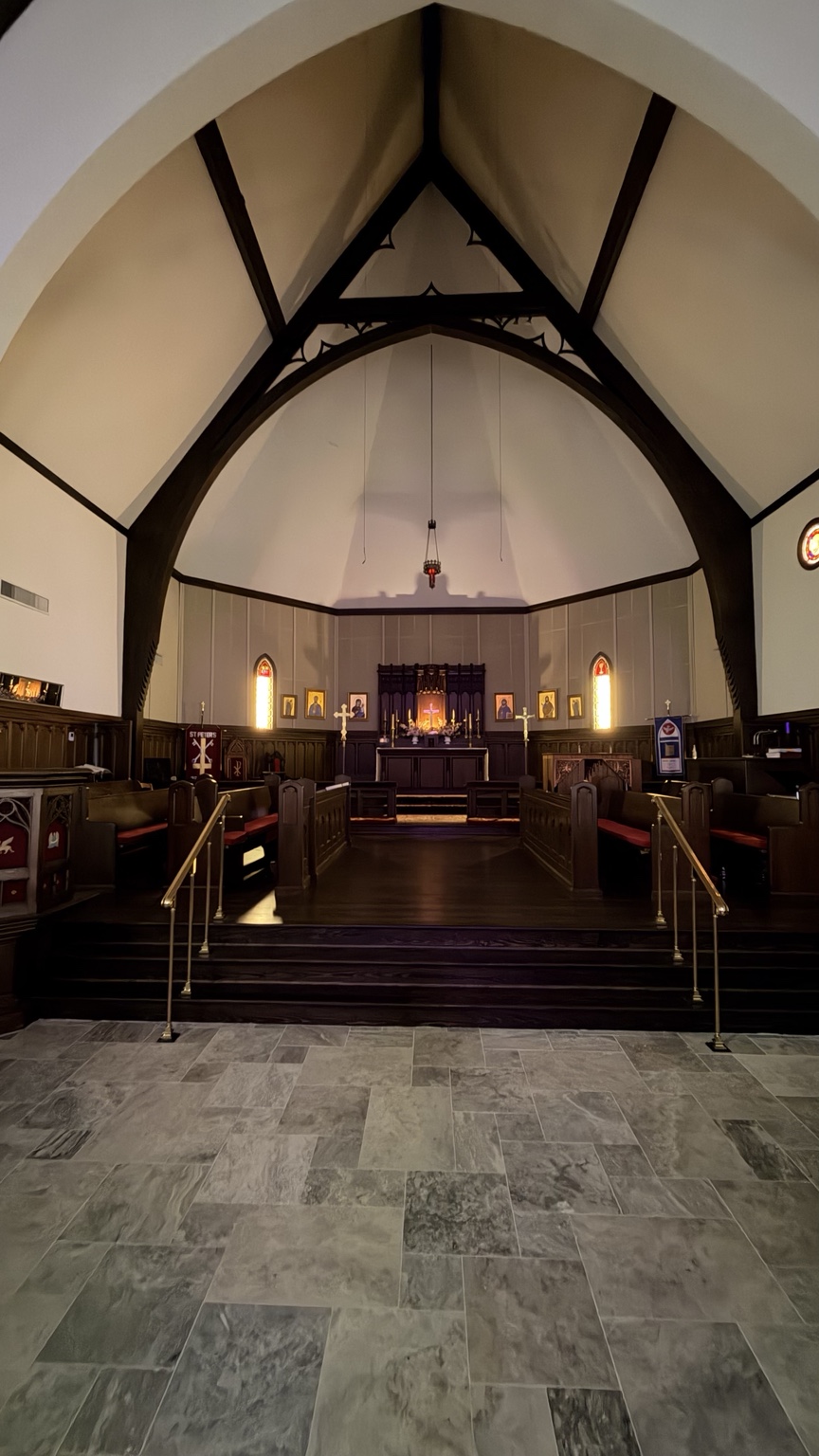
St. Peter’s chancel and altar

The chancel and altar

A view toward the altar, showing the chancel woodwork and surrounding arches.

Music and the voice of the church

The Pilcher organ and the historic bell

A tradition of music

The book distinguishes a hand-pumped Pilcher pipe organ installed in 1909 from an electric instrument purchased through the Women of the Church around 1920 and described as a 1921 Pilcher. George Babb’s 1978 renovation was celebrated with a November 26 concert. An April 1979 recital program describes 1,263 wood and metal pipes, including wooden pipes sixteen feet tall.

Sources: parish history, pp. 172–173, 256. These specifications describe the organ at that restoration.

The bell and the carillon

The parish history transcribes the old bell’s inscription as “Meneely and Co. 1852, West Troy, New York.” It records that the bell had cracked and was no longer being rung when the book was written. A separate Ambassador Carillon was purchased from Schulmerich in 1976 with memorial gifts. The bell and the carillon are distinct parts of the church’s history.

Sources: parish history, pp. 120–121. The account describes operation at the time of the book, rather than establishing present condition.
The church in photographs

More views of St. Peter’s

Additional views of the nave and memorial windows show details cherished by the parish. Select any photograph on this page to view the full image.

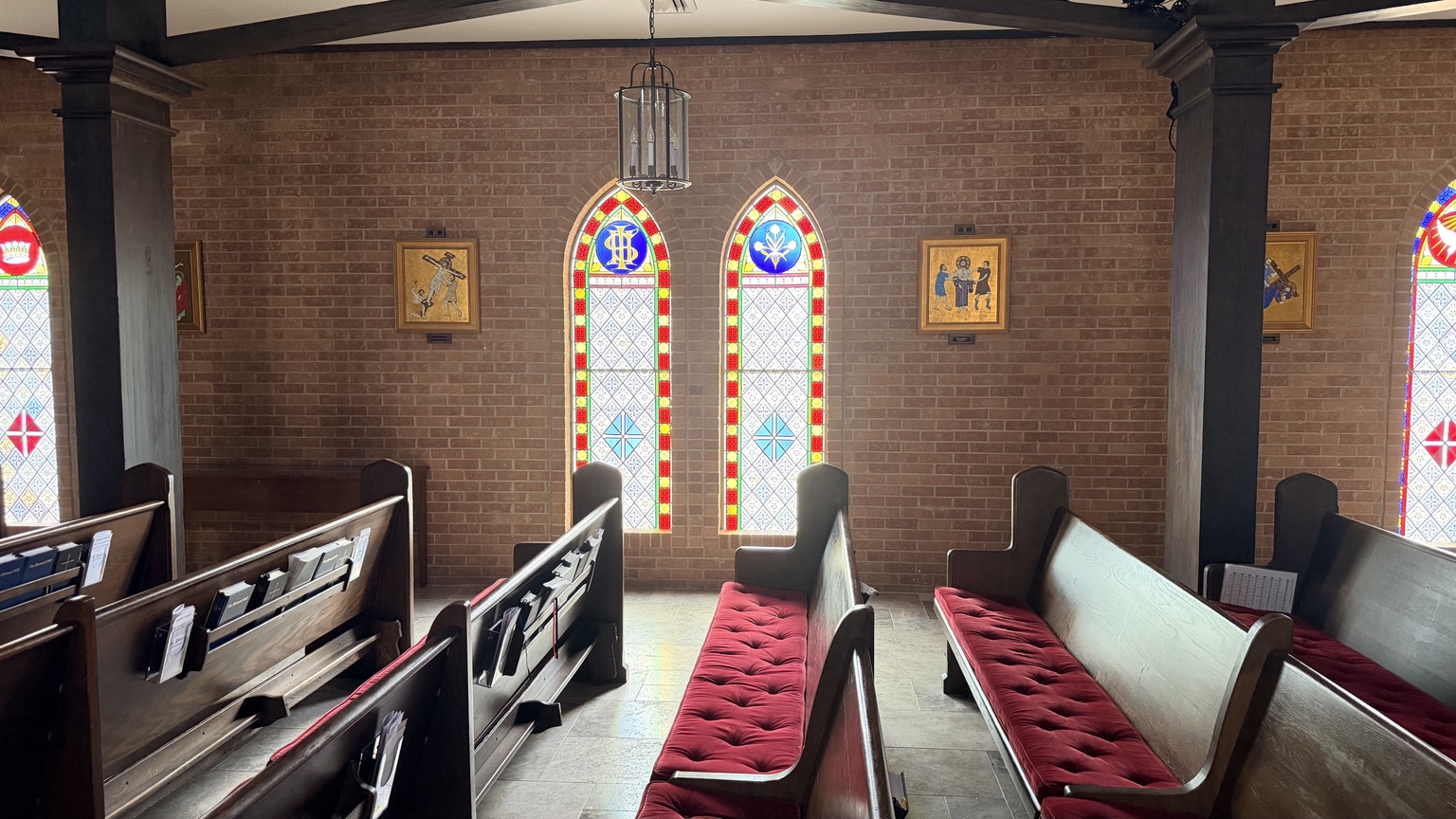
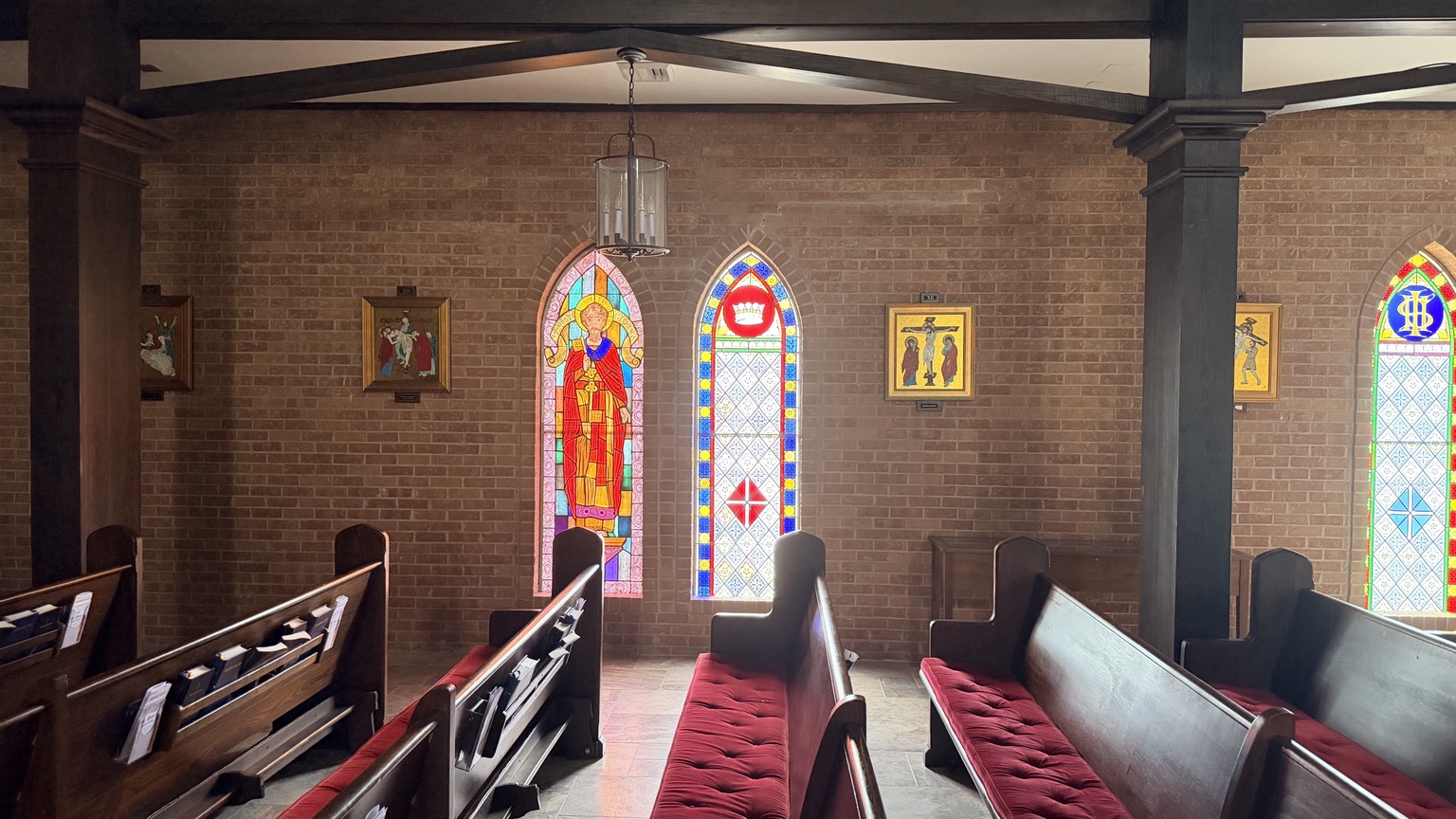
Memorial windows and wooden pews along the nave wall

Memorial windows and pews

A side view of the nave’s stained glass, wooden pews, and Stations of the Cross.

Memorial windows beside the church entrance

Windows near the entrance

Another pair of memorial windows beside the entrance and nave seating.

From the parish archives

Rectors in the photographs

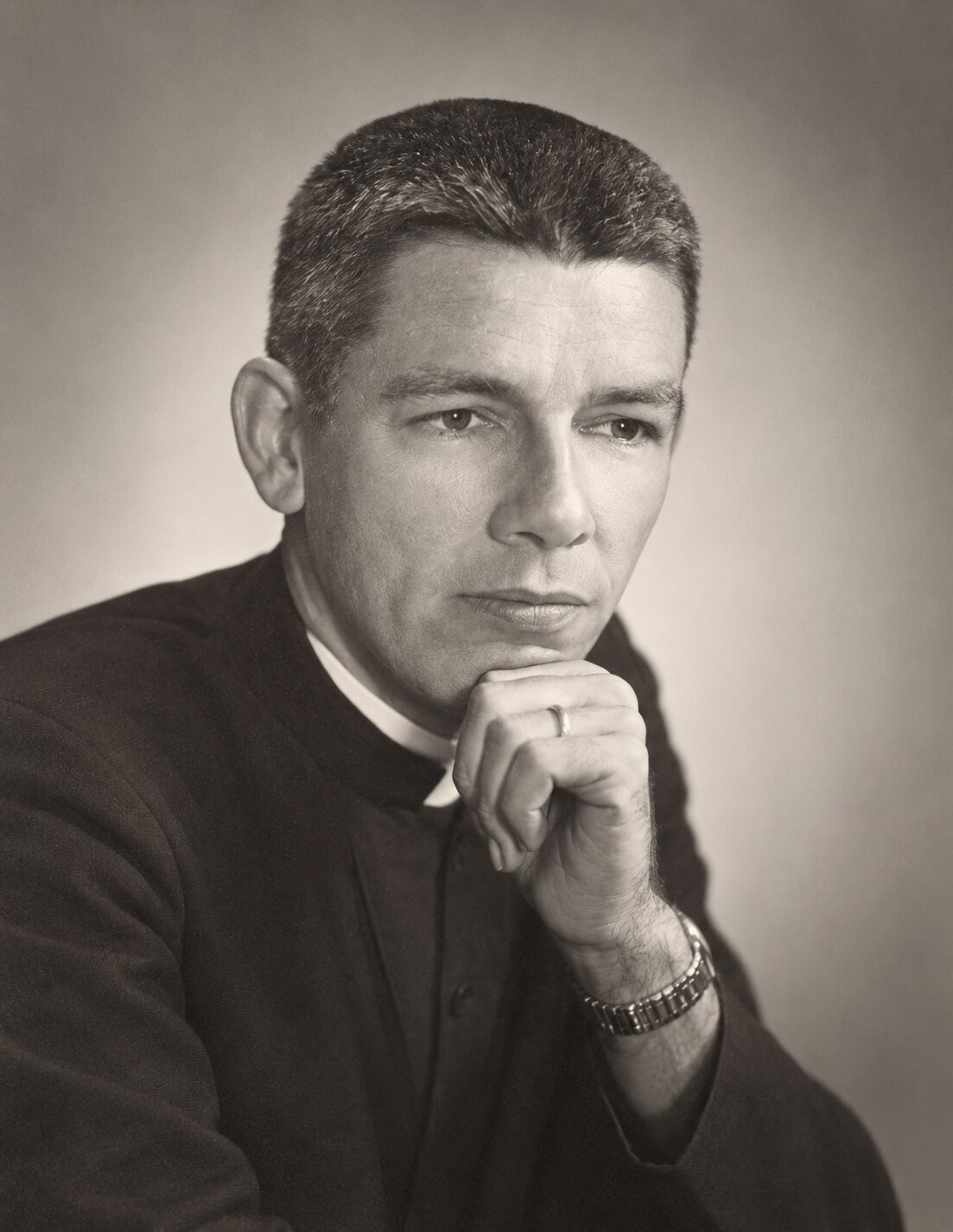
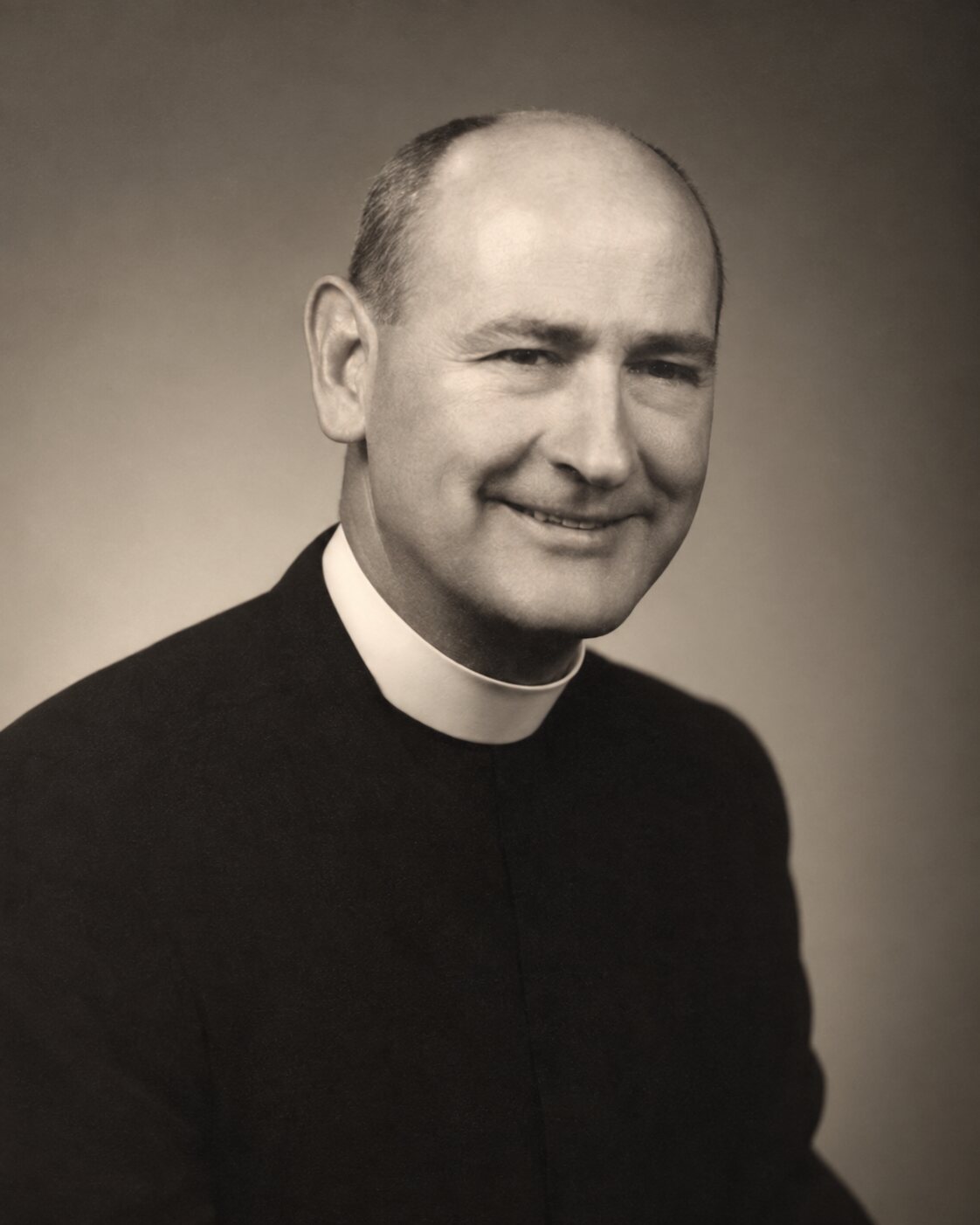
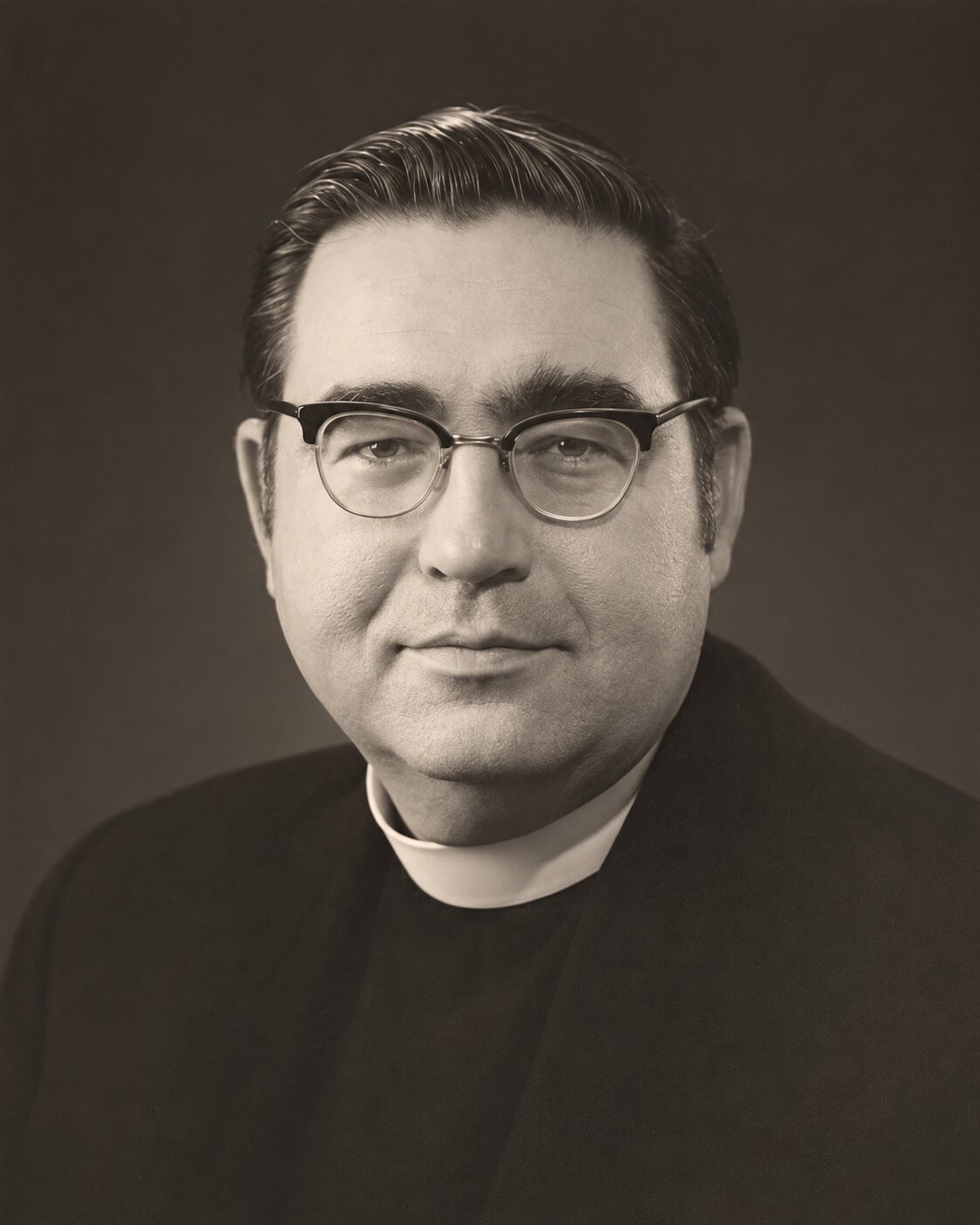
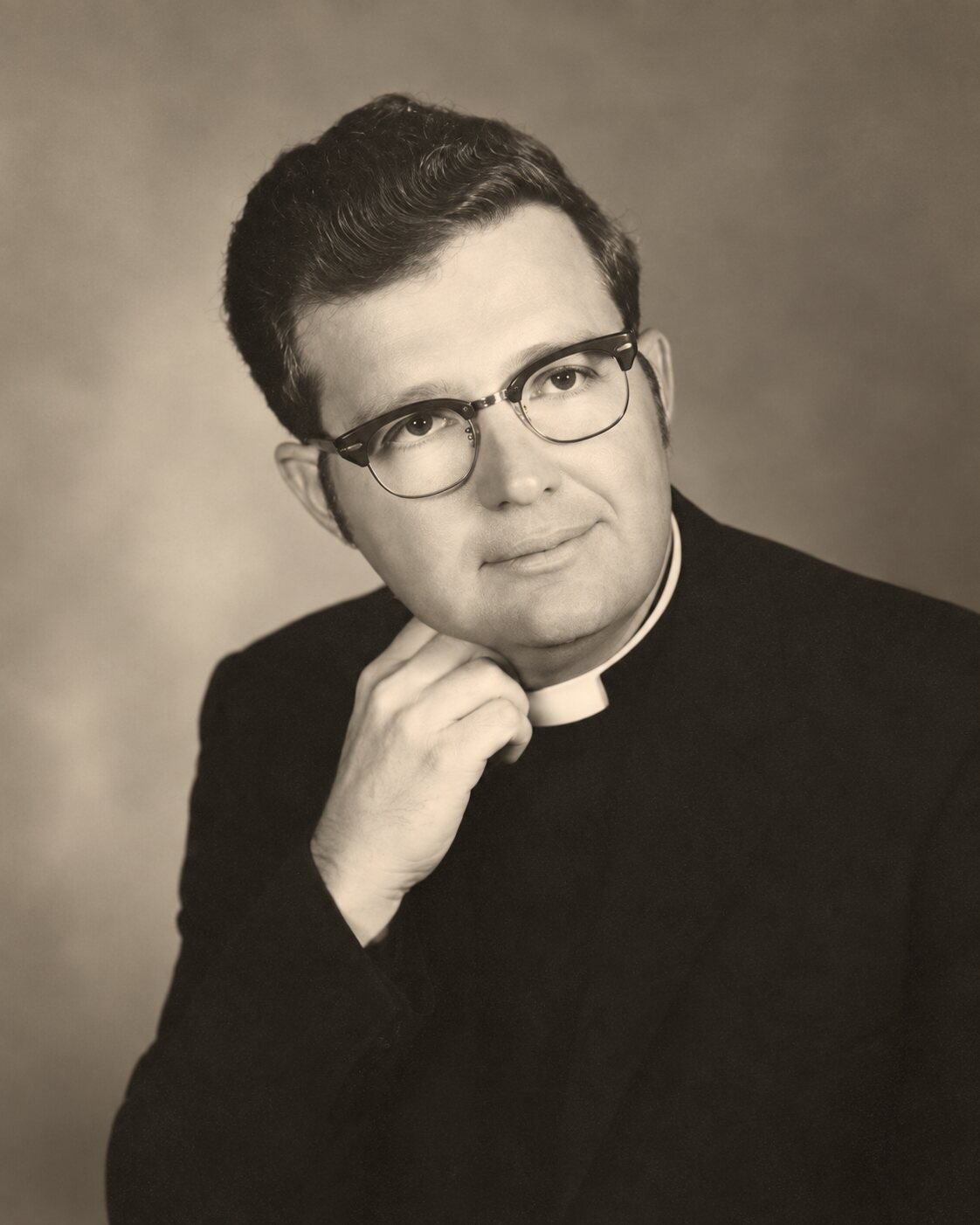
The parish’s framed portraits trace rectors from its first years through the twenty-first century. Dates below follow the portrait plaques and parish history; service sometimes came in separate terms.

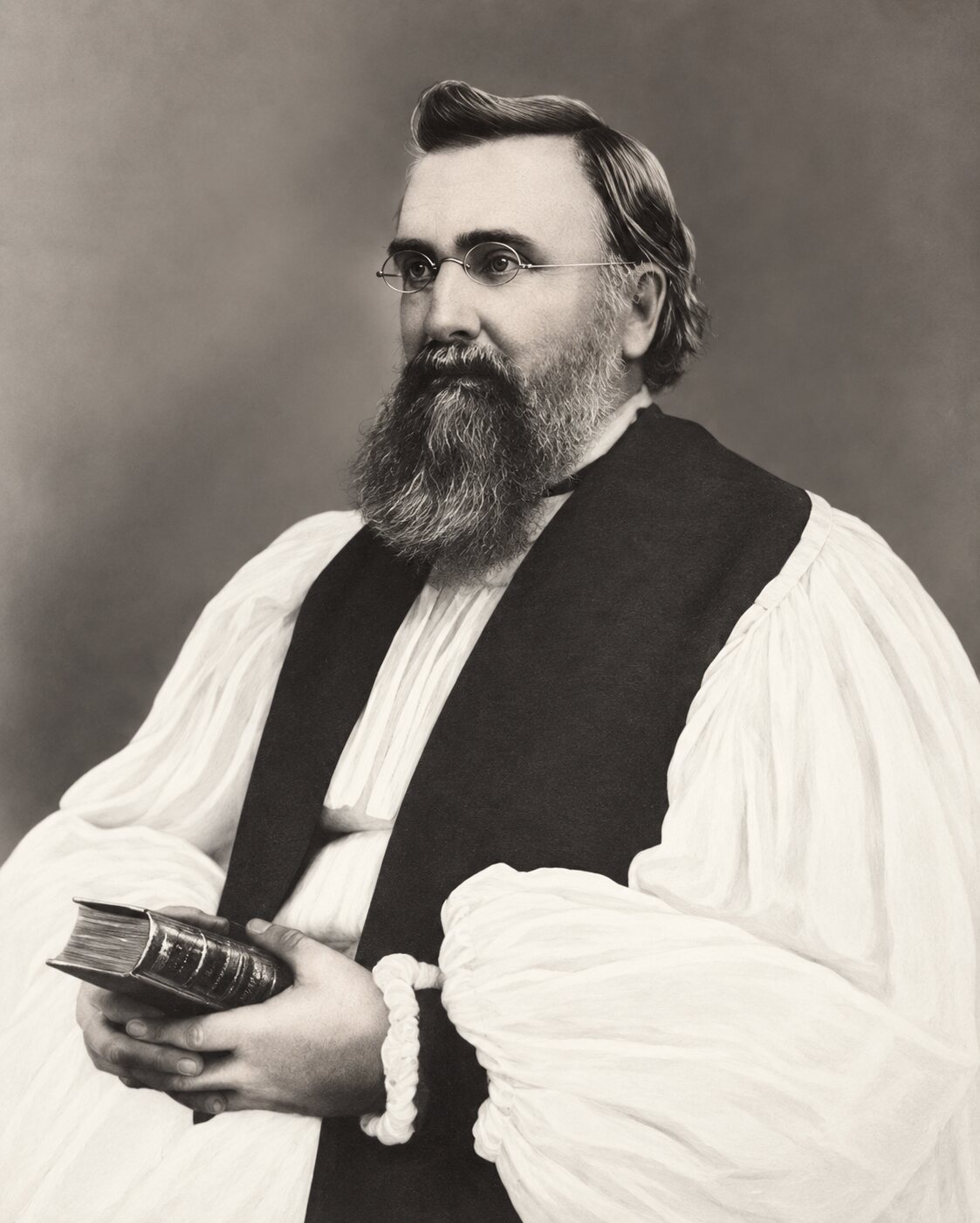
Portrait of the Rt. Rev. Henry Niles Pierce

The Rt. Rev. Henry Niles Pierce

First rector, 1848–1852
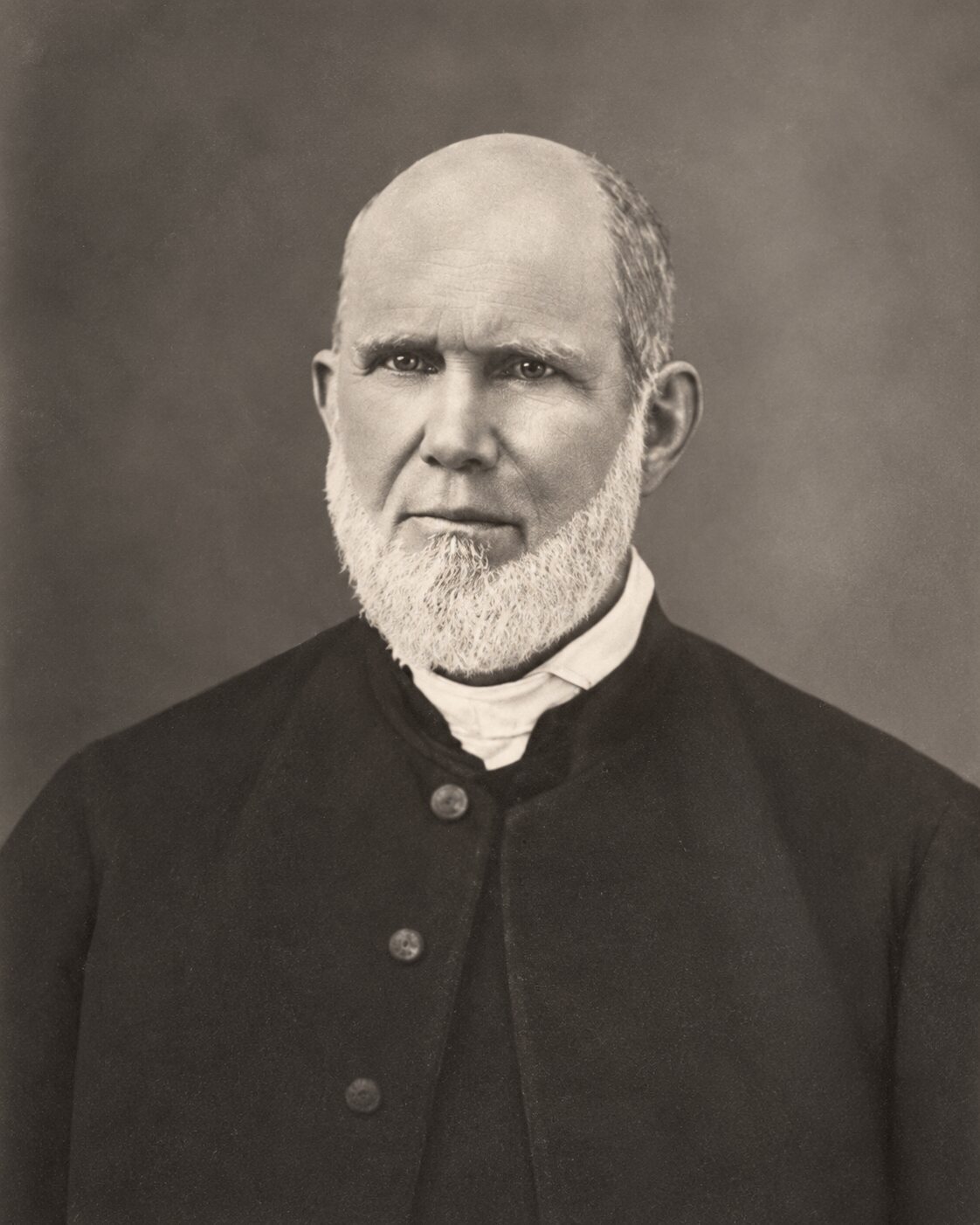
Portrait of the Rev. Lindsey Powell Rucker

The Rev. Lindsey Powell Rucker

1853–1854; later terms through 1886
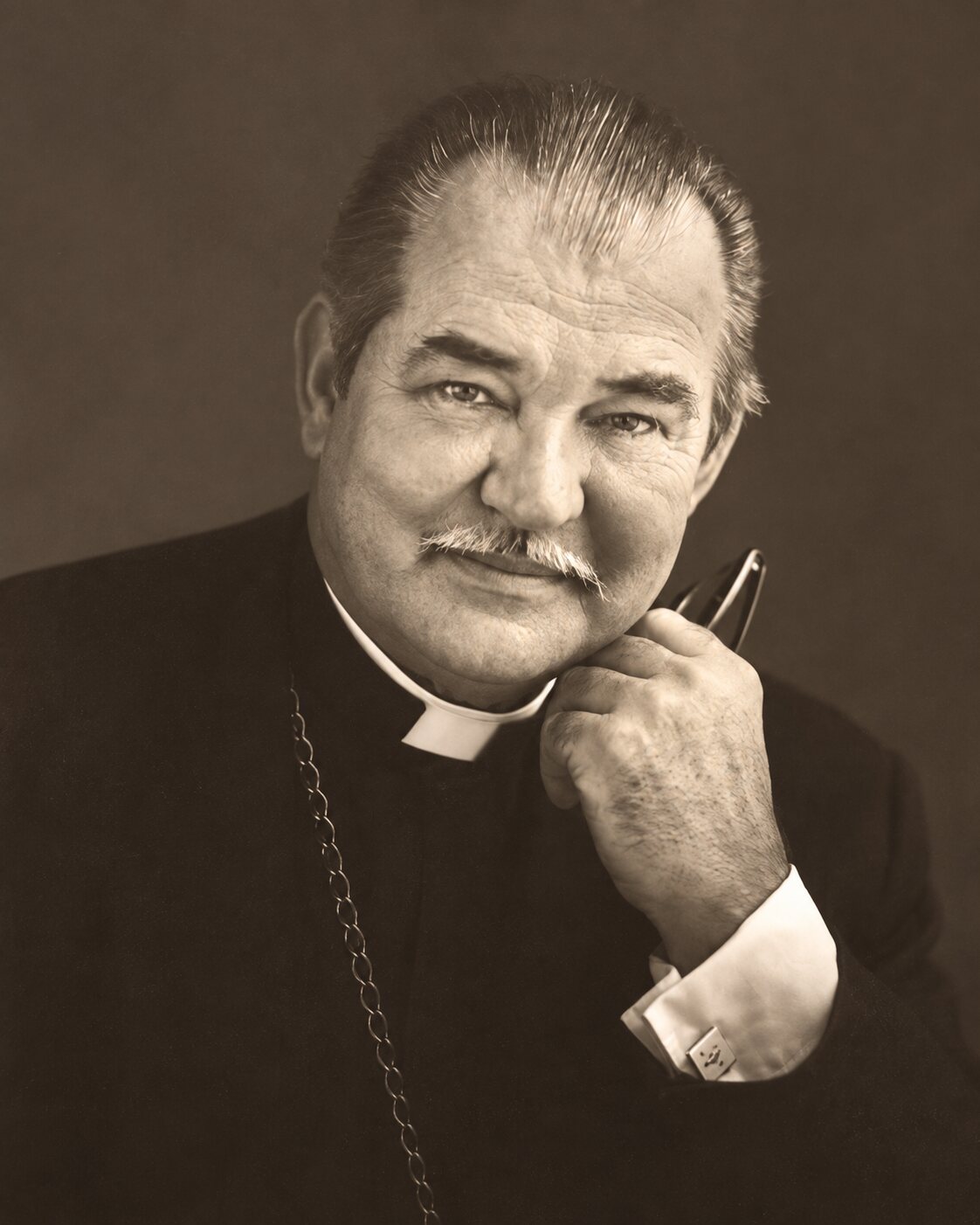
Portrait of the Rev. S. Moylan Bird

The Rev. S. Moylan Bird

1905–1921; 1929–1955
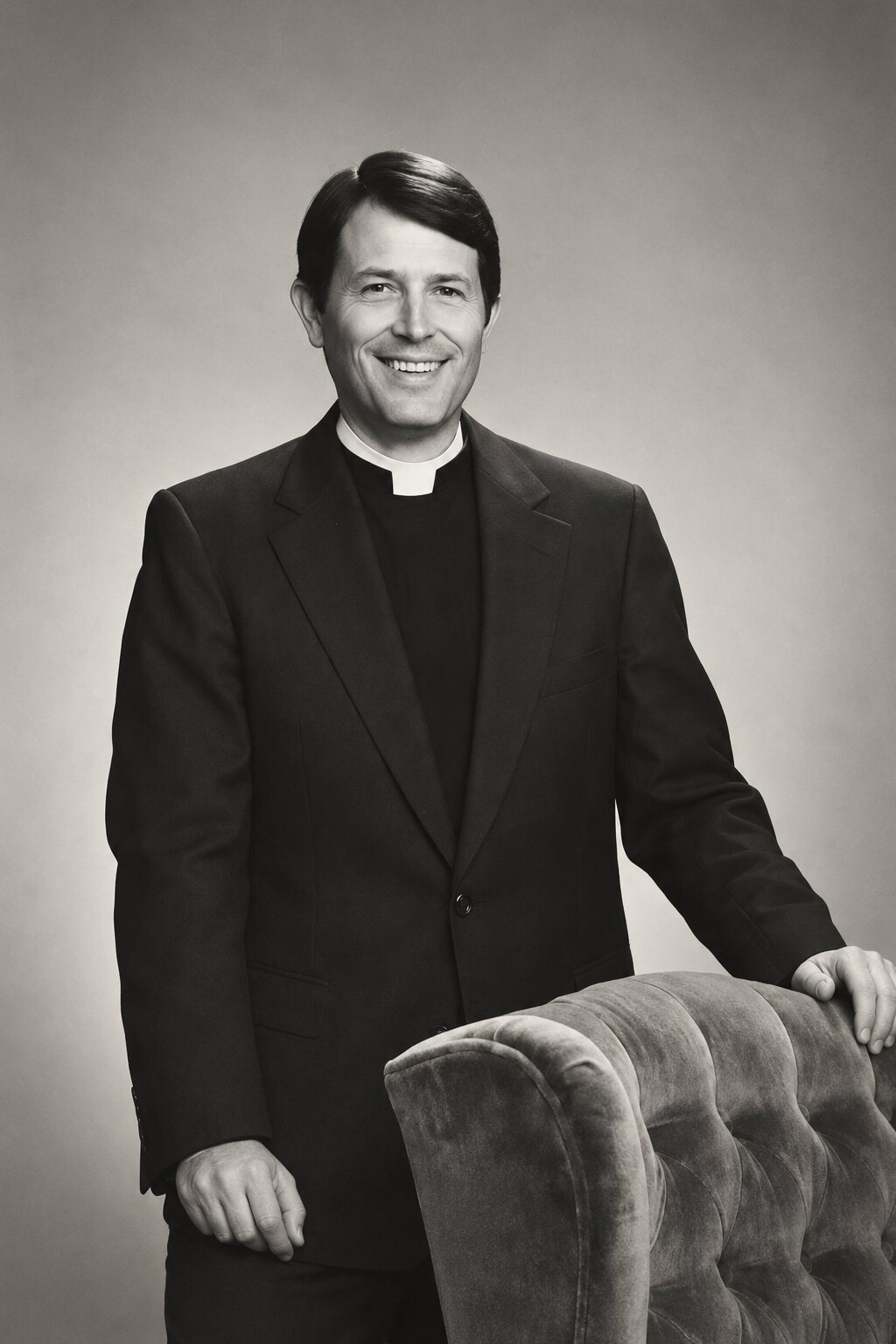
Portrait of the Rev. Clarence H. Lake

The Rev. Clarence H. Lake

1925–1929
Portrait of the Rev. Herbert J. Beadle Jr.

The Rev. Herbert J. Beadle Jr.

1955–1959
Portrait of the Rev. James L. Considine Jr.

The Rev. James L. Considine Jr.

1959–1963
Portrait of the Rev. Joseph H. Frazer Jr.

The Rev. Joseph H. Frazer Jr.

1964–1969
Portrait of the Rev. James E. Scott Jr.

The Rev. James E. Scott Jr.

1970–1972
Portrait of the Rev. Billy Tomlin

The Rev. Billy Tomlin

1972–1977
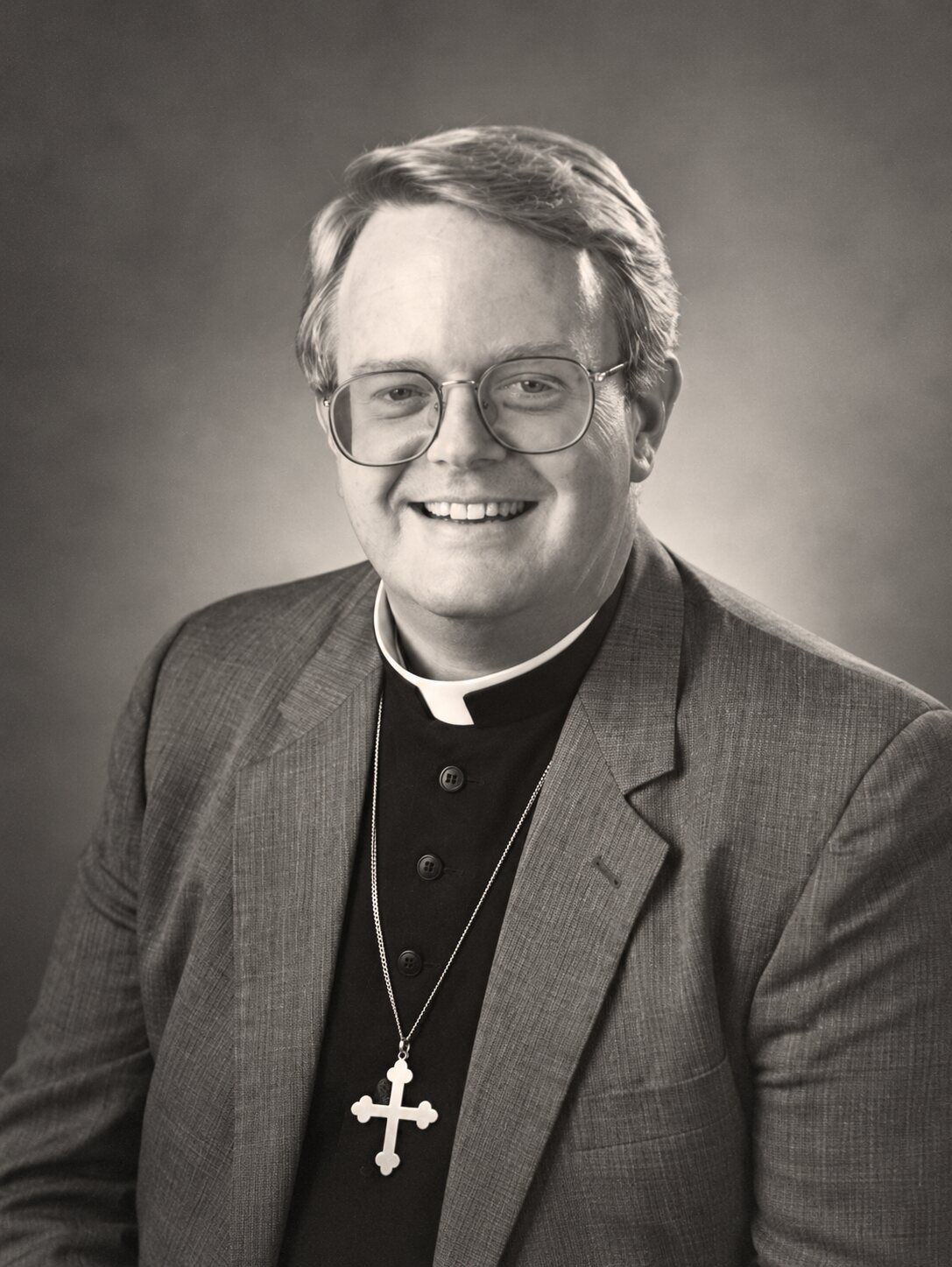
Portrait of the Rev. John R. Bentley Jr.

The Rev. John R. Bentley Jr.

1977–1984
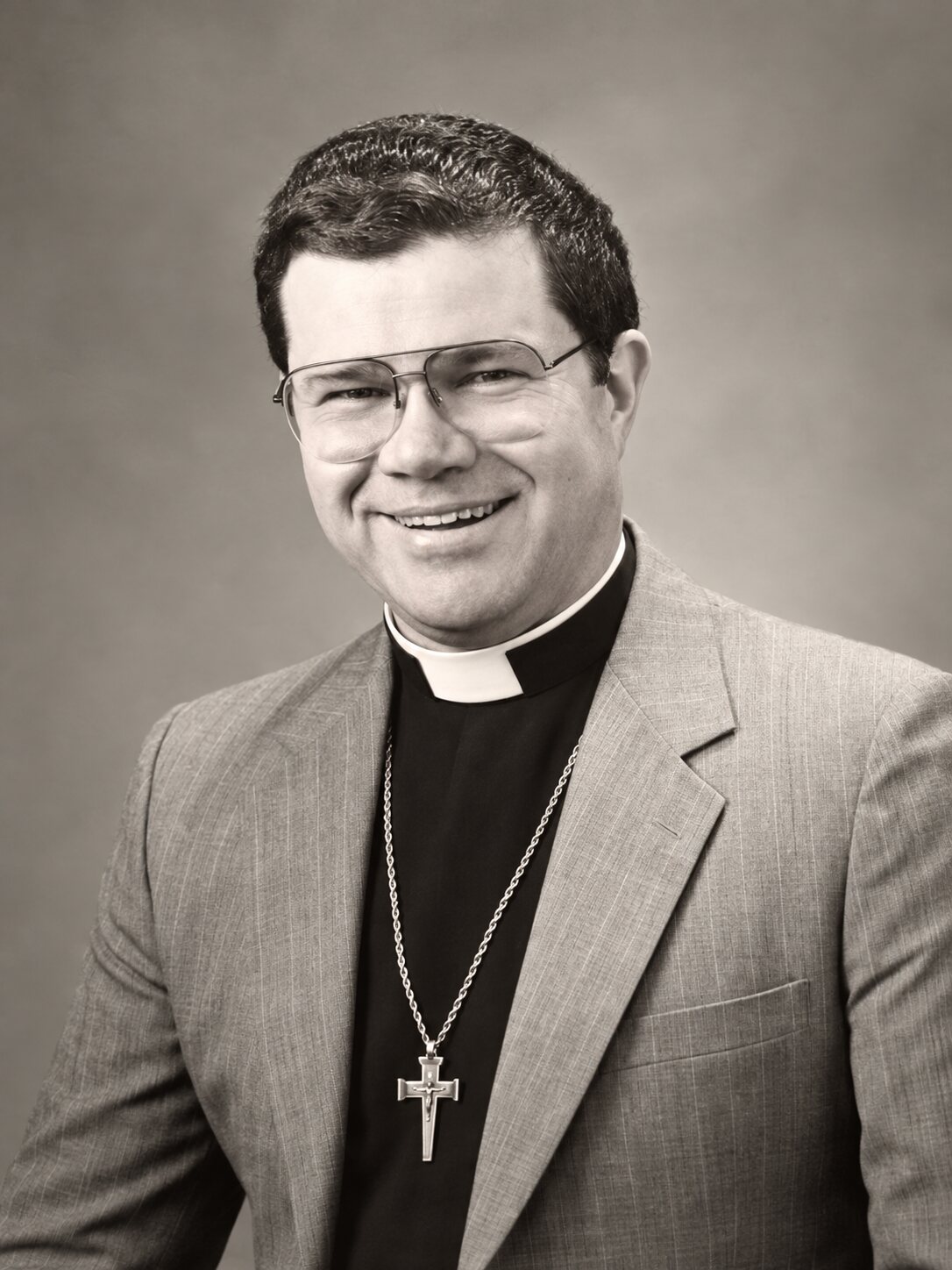
Portrait of the Rev. Bob Gribble

The Rev. Bob Gribble

1985–1989
Portrait of the Rev. Bruce Laird

The Rev. Bruce Laird

1989–1993
Portrait of the Rev. Carl Shannon Jr.

The Rev. Carl Shannon Jr.

1993–1996
Portrait of the Rev. Cecilia B. Smith

The Rev. Cecilia B. Smith

1997–2007
Portrait of the Rev. David K. Ottsen

The Rev. David K. Ottsen

2008–2017
Portrait of the Rev. Stephen F. Whaley

The Rev. Stephen F. Whaley

Called as rector in 2018

Other documented rectors

The clergy list in the parish history also names the Rev. Charles F. Rottenstein (1852–1853), the Rev. Elisha H. Downing (1854–1857), the Rev. Daniel Shaver (1860–1862), the Rev. A. F. Dobb (1866–1867), the Rev. W. W. Patrick (1886–1888), the Rev. William Sharpe Jr. (1888–1890), the Rev. Fred Sebright Leigh (1890–1897), the Rev. George E. Lloyd (1898–1899), the Rev. James Noble (1899–1902), and the Rev. Ira Day Lang (1921–1925). It distinguishes the Rev. C. W. Stone as curate (1862–1865), the Rev. D. W. Chase (1865–1866) and the Rev. Robert S. Stuart (1903–1905) as locum tenens, and the Rev. C. M. Beckwith (1902–1903) as general missionary. Rucker’s service included separate rectorates, occasional ministry, a period as locum tenens in 1884–1886, and rector emeritus status until his death in 1890. Source: parish history, p. 100.

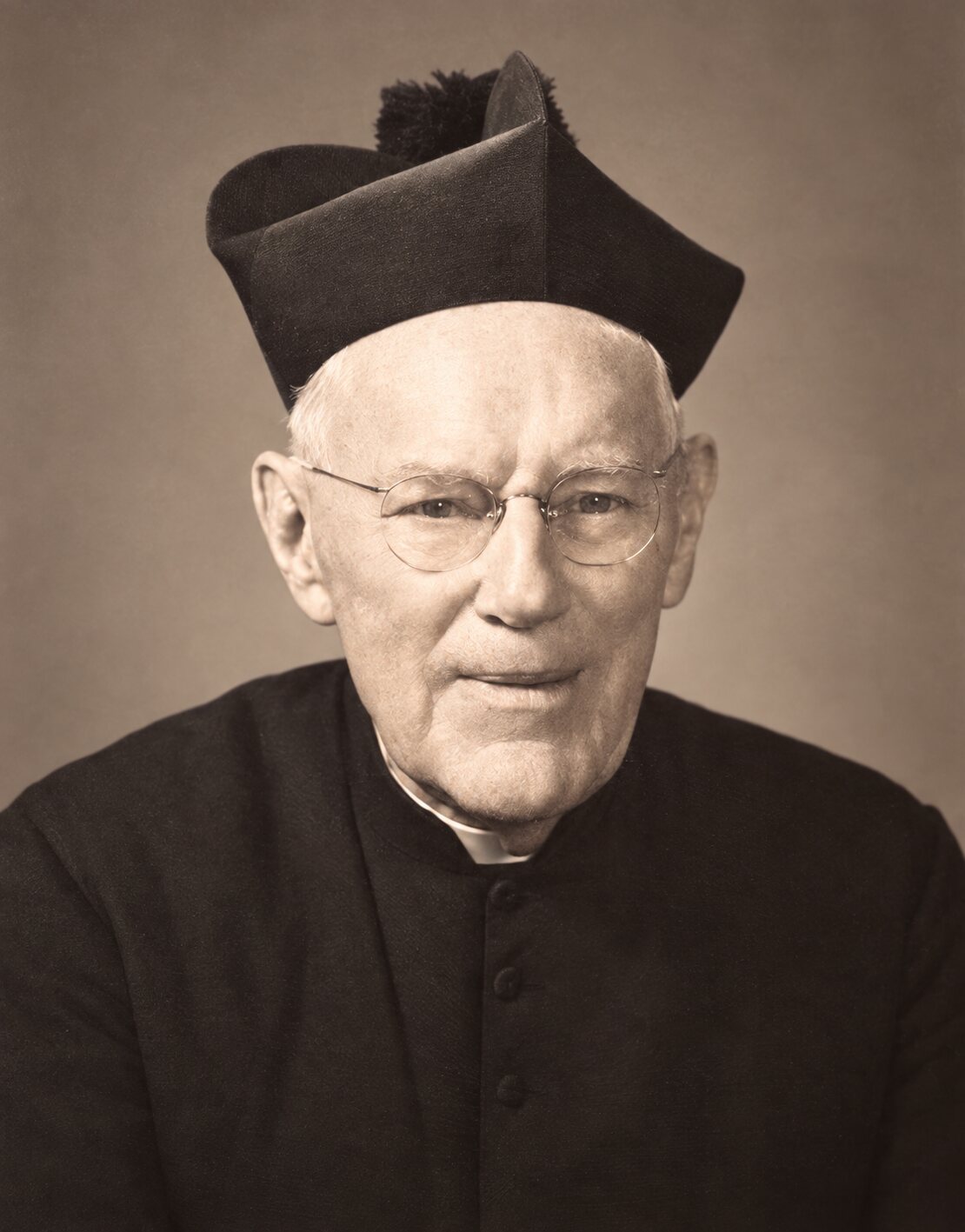
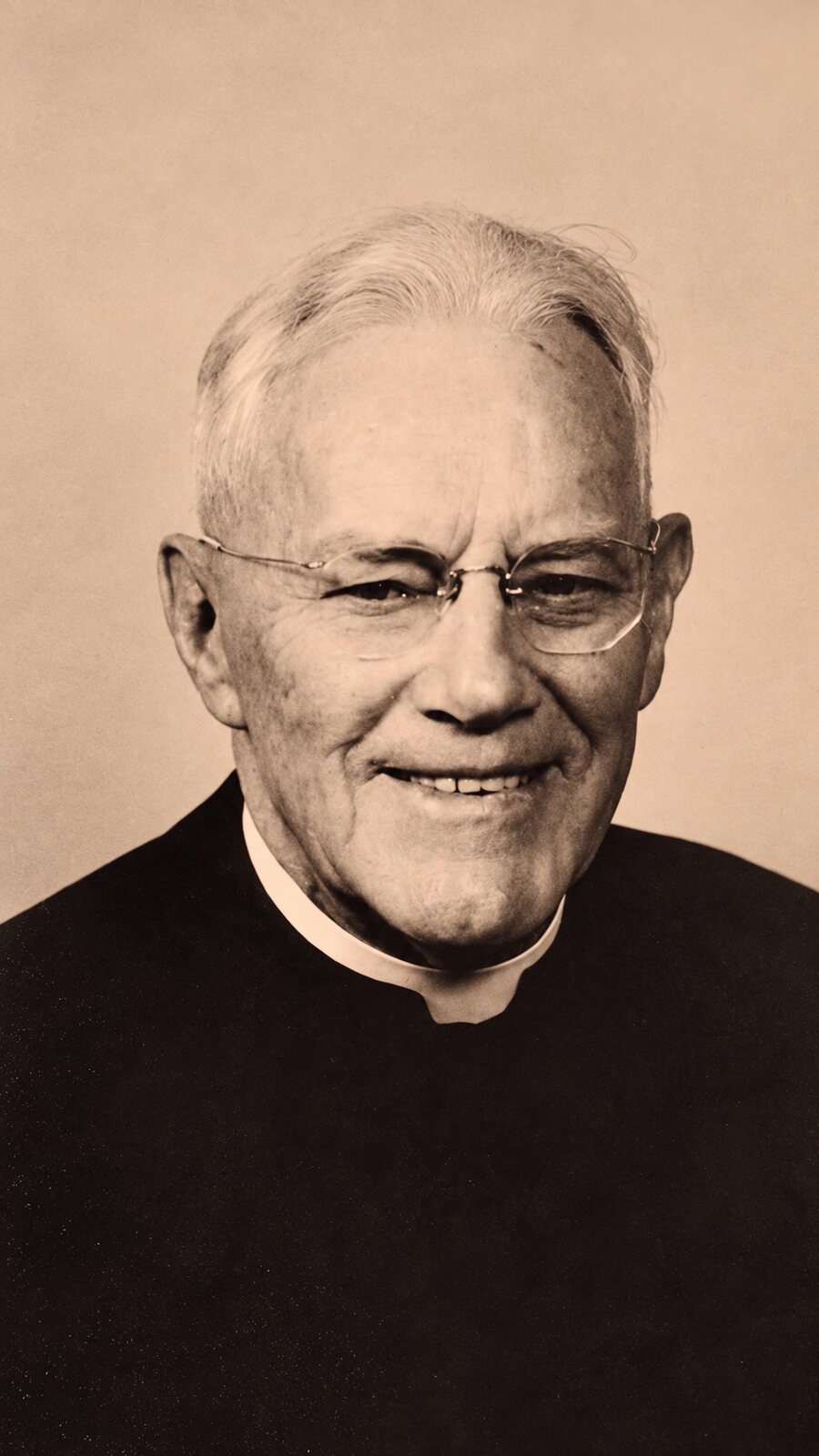
Portraits are digital cleanups of photographs of the parish’s framed display. Two additional portraits of Stephen Moylan Bird, identified by the parish’s framed nameplates, appear below. The original photographs and labels remain the archival reference. The list combines the surviving portrait labels with names recorded in the parish history. Dates draw on the parish history and portrait labels; some early building details and the spelling of Frazer/Fraser remain under review.

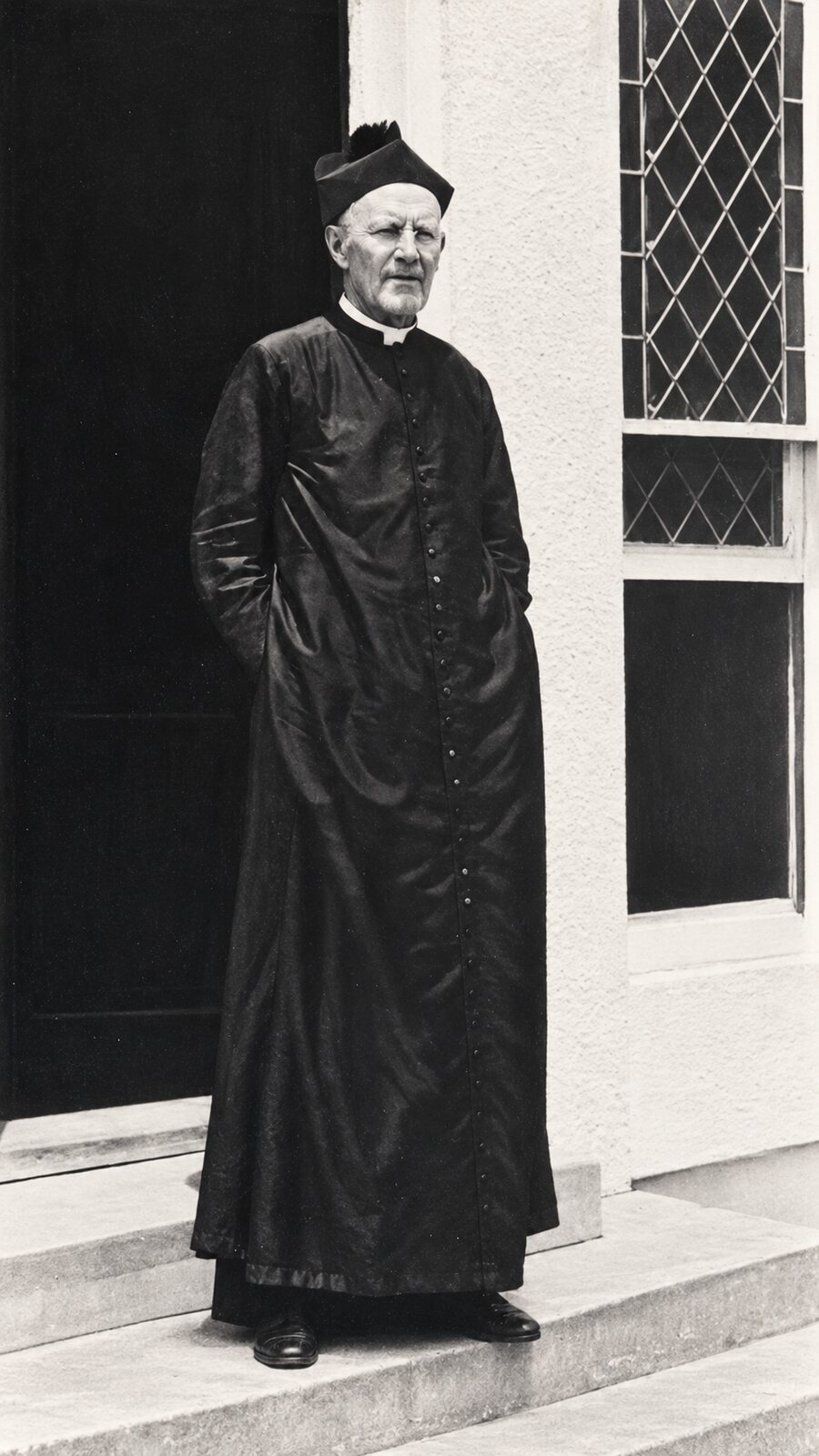
Additional portrait of the Rev. S. Moylan Bird

The Rev. S. Moylan Bird

Additional archival portrait
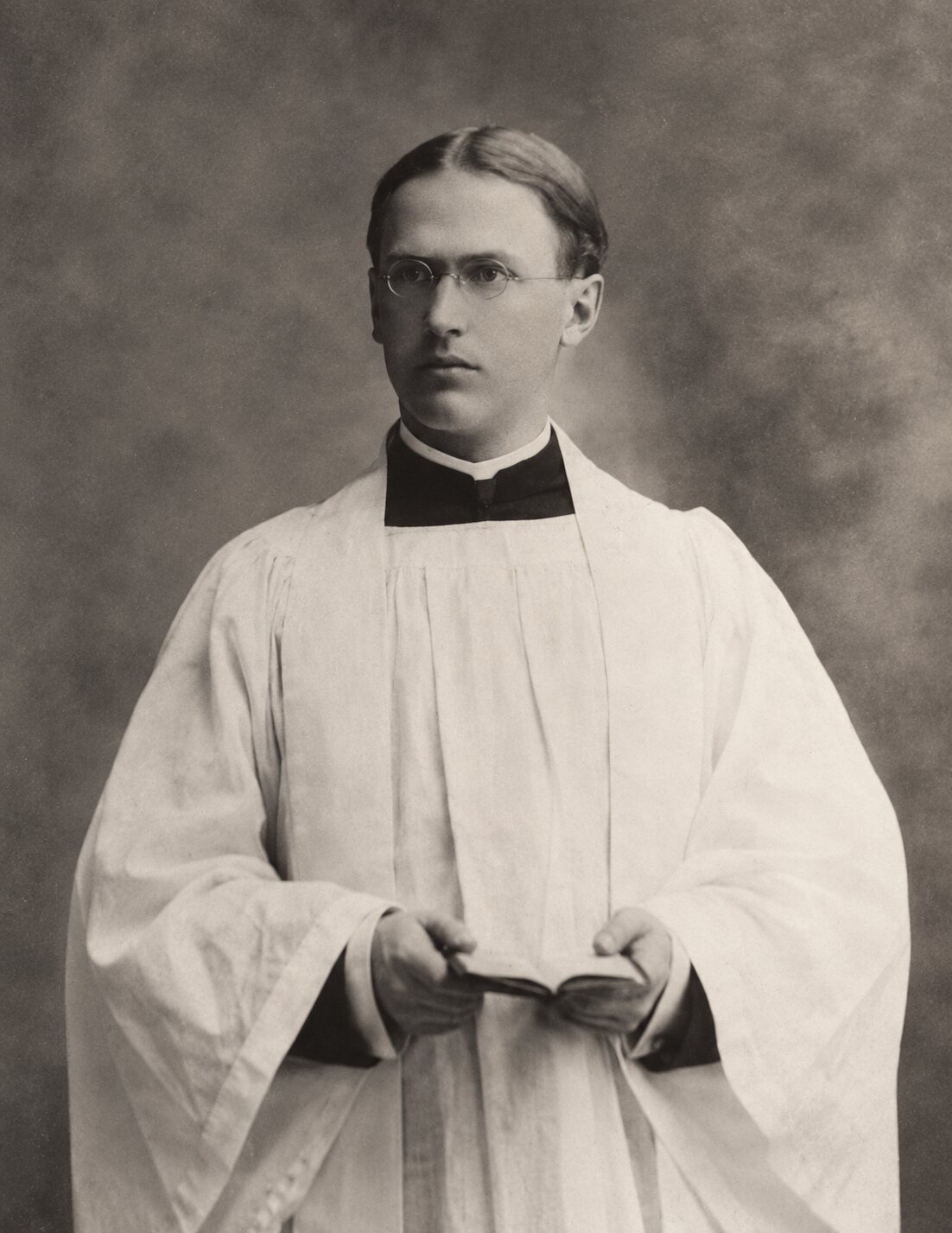
Additional portrait of the Rev. Stephen Moylan Bird

The Rev. Stephen Moylan Bird

Rector 1905–1921; 1929–1955
worship at st. peters

Be a part of our history.

Sundays - 8:00 & 10:30